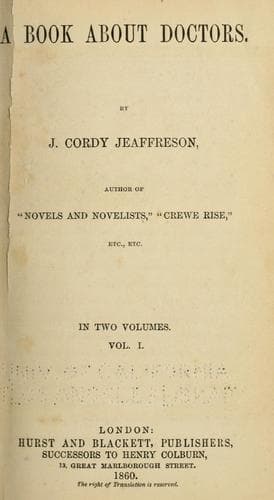
Medicine -- Anecdotes; Physicians -- Great Britain
The eccentric Dr. Glyn of Cambridge, rarely dined, but used to satisfy
his hunger at chance times by cutting slices off a cold joint (a
constant ornament of the side-table in his study), and eating them
while standing. To eat such a dinner in such an attitude would be to
fare little better than the ascetic physician who used twice a week to
dine off two Abernethy biscuits, consumed as he walked at the pace of
four miles an hour. However wholesome they may be, the hard biscuits,
known as Abernethies (but in the construction of which, by-the-by,
Abernethy was no more concerned than were Wellington and Blucher in
making the boots that bear their names), are not convivial cates,
though one would rather have to consume them than the calomel
sandwiches which Dr. Curry (popularly called Dr. Calomel Curry) used
to give his patients.
CHAPTER IX.
FEES.
From the earliest times the Leech (Leighis), or healer, has found, in
the exercise of his art, not only a pleasant sense of being a public
benefactor, but also the means of private advancement. The use the
churchmen made of their medical position throughout Christendom (both
before and after that decree of the council of Tours, A.D. 1163, which
forbade priests and deacons to perform surgical operations in which
cauteries and incisions were employed), is attested by the broad acres
they extracted, for their religious corporations, as much from the
gratitude as from the superstition of their patients. And since the
Reformation, from which period the vocations of the spiritual and the
bodily physician have been almost entirely kept apart, the
practitioners of medicine have had cause to bless the powers of
sickness. A good story is told of Arbuthnot. When he was a young man
(ere he had won the patronage of Queen Anne, and the friendship of
Swift and Pope), he settled at Dorchester, and endeavoured to get
practice in that salubrious town. Nature obviated his good intentions:
he wished to minister to the afflicted, if they were rich enough to
pay for his ministrations, but the place was so healthy that it
contained scarce half-a-dozen sick inhabitants. Arbuthnot determined
to quit a field so ill-adapted for a display of his philanthropy.
"Where are you off to?" cried a friend, who met him riding post
towards London. "To leave your confounded place," was the answer, "for
a man can neither live nor die there." But to arrive at wealth was not
amongst Arbuthnot's faculties; he was unable to use his profession as
a trade; and only a few weeks before his death he wrote, "I am as well
as a man can be who is gasping for breath, and has a house full of men
and women unprovided for."
Public-domain text, read in full here on John Shaqi.
Reviews
Reviews
No reviews yet
Be the first to share your thoughts on this work.
Elsewhere in the archive
Join the Discussion
Join the discussion
Sign in to leave a comment or review.
Sign InorCreate an account