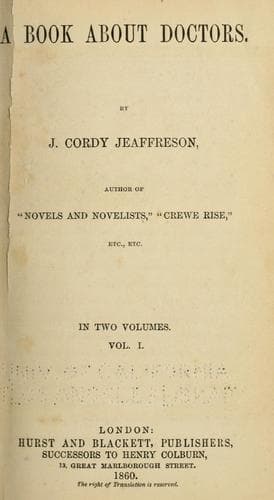
Medicine -- Anecdotes; Physicians -- Great Britain
Arbuthnot's ill-luck, however, was quite out of the ordinary rule.
Fuller says (1662), "Physic hath promoted many more, and that since
the reign of King Henry VIII. Indeed, before his time, I find a doctor
of physic, father to Reginald, first and last Lord Bray. But this
faculty hath flourished much the three last fifty years; it being true
of physic, what is said of Sylla, 'suos divitiis explevit.' Sir
William Butts, physician to King Henry VIII., Doctor Thomas Wendy, and
Doctor Hatcher, Queen Elizabeth's physician, raised worshipful
families in Norfolk, Cambridge, and Lincolnshire, having borne the
office of Sheriff in this county." Sir William Butts was rewarded for
his professional services by Henry VIII. with the honour of
Knighthood, and he attended that sovereign when the royal confirmation
was given, in 1512, to the charter of the barber-surgeons of London.
Another eminent physician of the same period, who also arrived at the
dignity of knighthood, was John Ayliffe, a sheriff of London, and
merchant of Blackwell-Hall. His epitaph records:--
"In surgery brought up in youth,
A knight here lieth dead;
A knight and eke a surgeon, such
As England seld' hath bred.
"For which so sovereign gift of God,
Wherein he did excell,
King Henry VIII. called him to court,
Who loved him dearly well.
"King Edward, for his service sake,
Bade him rise up a knight;
A name of praise, and ever since
He Sir John Ayliffe hight."
This mode of rewarding medical services was not unfrequent in those
days, and long before. Ignorance as to the true position of the barber
in the middle ages has induced the popular and erroneous belief that
the barber-surgeon had in olden times a contemptible social status.
Unquestionably his art has been elevated during late generations to a
dignity it did not possess in feudal life; but it might be argued with
much force, that the reverse has been the case with regard to his
rank. Surgery and medicine were arts that nobles were proud to
practise for honour, and not unfrequently for emolument. The reigns of
Elizabeth and her three predecessors in sovereign power abounded in
medical and surgical amateurs. Amongst the fashionable empirics
Bulleyn mentions Sir Thomas Elliot, Sir Philip Paris, Sir William
Gasgoyne, Lady Taylor and Lady Darrel, and especially that "goodly
hurtlesse Gentleman, Sir Andrew Haveningham, who learned water to kill
a canker of his own mother." Even an Earl of Derby, about this time,
was celebrated for his skill in _chirurgerie_ and _bone-setting_, as
also was the Earl of Herfurth. The Scots nobility were enthusiastic
dabblers in such matters; and we have the evidence of Buchanan and
Lindsay as to James IV. of Scotland, "quod vulnera scientissime
tractaret," to use the former authority's words, and in the language
of the latter, that he was "such a _cunning chirurgeon_, that none in
his realm who used that craft but would take his counsel in all their
Public-domain text, read in full here on John Shaqi.
Reviews
Reviews
No reviews yet
Be the first to share your thoughts on this work.
Elsewhere in the archive
Join the Discussion
Join the discussion
Sign in to leave a comment or review.
Sign InorCreate an account