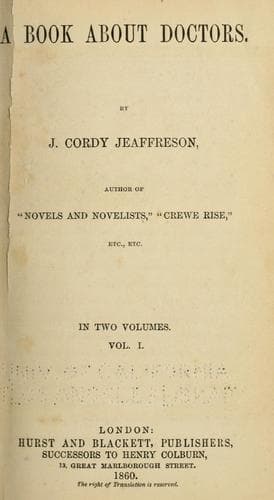
Medicine -- Anecdotes; Physicians -- Great Britain
At a very early period in England a doctor looked for his palm to be
crossed with gold, if his patient happened to be a man of condition.
In Henry VIII.'s reign a Cambridge physician was presented by the Earl
of Cumberland with a fee of £1--but this was at least double what a
commoner would then have paid. Stow complains that while in Holland
half-a-crown was looked upon as a proper remuneration for a single
visit paid by a skilled physician, the medical practitioners of London
scorned "to touch any metal but gold."
It is no matter of uncertainty what the physician's ordinary fee was
at the close of the sixteenth and the commencement of the seventeenth
century. It was ten shillings, as is certified by the following
extract from "Physick lies a-bleeding: the Apothecary turned
Doctor"--published in 1697:--
"_Gallipot_--Good sir, be not so unreasonably passionate and I'll tell
you. Sir, the Pearl Julep will be 6_s._ 8_d._, Pearls being dear since
our clipt money was bought. The Specific Bolus, 4_s._ 6_d._, I never
reckon less; my master in Leadenhall Street never set down less, be it
what it would. The Antihysterick Application 3_s._ 6_d._ (a common one
is but 2_s._ 6_d._), and the Anodyne Draught 3_s._ 4_d._--that's all,
sir; a small matter and please you, sir, for your lady. My fee is what
you please, sir. All the bill is _but_ 18_s._
"_Trueman_--Faith, then, d'ye make a _but_ at it? I do suppose, to be
very genteel, I must give you a crown.
"_Gallipot_--If your worship please; I take it to be a fair and an
honest bill.
"_Trueman_--Do you indeed? But I wish you had called a doctor, perhaps
he would have advised her to have forebore taking anything, as yet at
least, so I had saved 13_s._ in my pocket."
"Physick lies a-bleeding" was written during the great Dispensarian
War, which is touched upon in another part of these pages; and its
object was to hold up physicians as models of learning and probity,
and to expose the extortionate practices of the apothecaries. It must
therefore be read with caution, and with due allowance for the license
of satire, and the violence of a party statement. But the statement
that 10_s._ was the _customary_ fee is clearly one that may be
accepted as truthful. Indeed, the unknown and needy doctors were glad
to accept less. The author of "The Dispensarians are the Patriots of
Britain," published in 1708, represents the humbler physicians being
nothing better than the slaves of the opulent apothecaries, accepting
half their right fee, and taking instead 25 or 50 per cent. of the
amount paid for drugs to the apothecary. "They (the powerful
traders)," says the writer, "offered the Physicians 5_s._ and 10_s._
in the pound, to excite their industry to prescribe the larger
abundance to all the disorders."
Public-domain text, read in full here on John Shaqi.
Reviews
Reviews
No reviews yet
Be the first to share your thoughts on this work.
Elsewhere in the archive
Join the Discussion
Join the discussion
Sign in to leave a comment or review.
Sign InorCreate an account