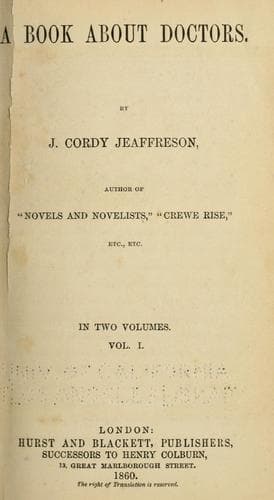
Medicine -- Anecdotes; Physicians -- Great Britain
"Good day to you, Mr. Bouvart; I feel quite in spirits, and think my
fever has left me."
"I am sure it has," replied Bouvart, dryly. "The very first expression
you used convinced me of it."
"Pray, explain yourself."
"Nothing is easier. In the first days of your illness, when your life
was in danger, I was your _dearest friend_; as you began to get
better, I was your _good Bouvart_; and now I am Mr. Bouvart: depend
upon it you are quite recovered."
In fact, the affection of a patient for his physician is very like the
love a candidate for a borough has for an individual elector--he is
very grateful to him, till he has got all he wants out of him. The
medical practitioner is unwise not to recognize this fact. Common
prudence enjoins him to act as much as possible on the maxim of
"accipe dum dolet"--"take your fee while your patient is in pain."
But though physicians have always held themselves open to take as much
as they can get, their ordinary remuneration has been fixed in divers
times by custom, according to the locality of their practice, the rank
of their patients, the nature of the particular services rendered, and
such other circumstances. In China the rule is "no cure, no pay," save
at the Imperial court, where the physicians have salaries that are cut
off during the continuance of royal indisposition. For their sakes it
is to be hoped that the Emperor is a temperate man, and does not
follow the example of George the Fourth, who used to drink Maraschino
between midnight and four o'clock in the morning; and then, when he
awoke with a furred tongue, from disturbed sleep, used to put himself
under the hands of his doctors. Formerly the medical officers of the
English monarch were paid by salary, though doubtless they were
offered, and were not too proud to accept, fees as well. Coursus de
Gungeland, Edward the Third's apothecary, had a pension of sixpence
a-day--a considerable sum at that time; and Ricardus Wye, the surgeon
of the same king, had twelve-pence a day, and eight marks per annum.
"Duodecim denarios per diem, et octo marcas per annum, pro vadiis suis
pro vitâ." In the royal courts of Wales, also, the fees of surgeons
and physicians were fixed by law--a surgeon receiving, as payment for
curing a slight wound, only the blood-stained garments of the injured
person; but for healing a dangerous wound he had the bloody apparel,
his board and lodging during the time his services were required, and
one hundred and eighty pence.
Public-domain text, read in full here on John Shaqi.
Reviews
Reviews
No reviews yet
Be the first to share your thoughts on this work.
Elsewhere in the archive
Join the Discussion
Join the discussion
Sign in to leave a comment or review.
Sign InorCreate an account