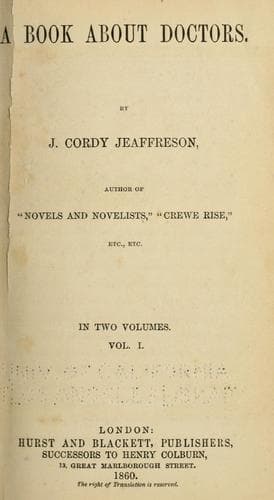
Medicine -- Anecdotes; Physicians -- Great Britain
The patients were not long in coming. The literary reputation he
obtained by his "Examination of Dr Woodward's Account of the Deluge,"
elicited by Woodward's "Essay towards a Natural History of the Earth,"
instead of frightening the sick from him, brought them to him.
Accidentally called in to Prince George of Denmark, when his Royal
Highness was suddenly taken ill at Epsom, he made himself so agreeable
that the casual introduction became a permanent connection. In 1709,
on the illness of Hannes (a physician who also understood the art of
rising in spite of obstacles) he was appointed physician-in-ordinary
to Queen Anne.
To secure the good graces of his royal patient, and rise yet higher in
them, he adopted a tone of affection for her as a person, as well as
loyal devotion to her as a queen. The fall of Radcliffe warned him
that he had need of caution in dealing with the weak-minded,
querulous, crotchety, self-indulgent invalid.
"What's the time?" asked the Queen of him one day.
"Whatever it may please your Majesty," answered the court-physician,
with a graceful bow.
After all, the best testimony of a man's merit is the opinion held of
him by those of his acquaintance who know him intimately--at home as
well as abroad. By all who came within the circle of Arbuthnot's
privacy he was respected as much as loved. And his associates were no
common men. Pope, addressing him as "the friend of his life," says:--
"Why did I write? what sin, to me unknown,
Dipp'd me in ink?--my parents' or my own?
As yet a child, nor yet a fool to fame,
I lisp'd in numbers, for the numbers came.
I left no calling for this idle trade,
No duty broke, no father disobey'd.
The muse but served to ease some friend, not wife,
To help me through this long disease, my life,
To second, Arbuthnot! thy art and care,
And teach the being you preserved to bear."
Pope's concluding wish--
"Oh, friend! may each domestic bliss be thine."
was ineffectual. Arbuthnot's health failed under his habits of
intemperance, and during his latter years he was a terrible sufferer
from asthma and melancholy. After the Queen's death he went for the
benefit of his health on the continent, and visited his brother, a
Paris banker. Returning to London he took a house in Dover Street,
from which he moved to the residence in Cork Street, Burlington
Gardens, where he died Feb. 27, 1734-5. He died in straitened
circumstances; for unlike his fellow-countryman, Colonel Chartres, he
had not the faculty of saving. But with failing energies, an
excruciated frame, and the heart-burden of a family unprovided for, he
maintained a philosophic equanimity, and displayed his old unvarying
consideration for all who surrounded him.
Arbuthnot's epitaph on Colonel Chartres (almost as well known as
Martinus Scriblerus) is a good specimen of his humour:--
Public-domain text, read in full here on John Shaqi.
Reviews
Reviews
No reviews yet
Be the first to share your thoughts on this work.
Elsewhere in the archive
Join the Discussion
Join the discussion
Sign in to leave a comment or review.
Sign InorCreate an account