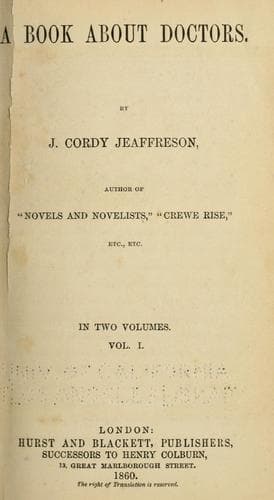
Medicine -- Anecdotes; Physicians -- Great Britain
Amongst our more celebrated and learned English physicians was John
Phreas, born about the commencement of the fifteenth century, and
educated at Oxford, where he obtained a fellowship on the foundation
of Balliol College. His M. D. degree he obtained in Padua, and the
large fortune he made by the practice of physic was also acquired in
Italy. He was a poet and an accomplished scholar. Some of his epistles
in MS. are still preserved in the Balliol Library and at the Bodleian.
His translation of Diodorus Siculus, dedicated to Paul II., procured
for him from that pontiff the fatal gift of an English bishopric. A
disappointed candidate for the same preferment is said to have
poisoned him before the day appointed for his consecration.
Of Thomas Linacre, successively physician to Henry VII., Henry VIII.,
Edward VI., and Princess Mary, the memory is still green amongst men.
At his request, in conjunction with the representations of John
Chambre, Fernandus de Victoria, Nicholas Halswell, John Fraunces,
Robert Yaxley (physicians), and Cardinal Wolsey, Henry VIII. granted
letters patent, establishing the College of Physicians, and conferring
on its members the sole privilege of practicing, and admitting persons
to practice, within the city, and a circuit of seven miles. The
college also was empowered to license practitioners throughout the
kingdom, save such as were graduates of Oxford and Cambridge--who were
to be exempt from the jurisdiction of the new college, save within
London and its precincts. Linacre was the first President of the
College of Physicians. The meetings of the learned corporation were
held at Linacre's private house, No. 5, Knight-Rider Street, Doctors'
Commons. This house (on which the Physician's arms, granted by
Christopher Barker, Garter King-at-arms, Sept. 20, 1546, may still be
seen,) was bequeathed to the college by Linacre, and long remained
their property and abode. The original charter of the brotherhood
states: "Before this period a great multitude of ignorant persons, of
whom the greater part had no insight into physic, nor into any other
kind of learning--some could not even read the letters and the
book--so far forth, that common artificers, as smiths, weavers and
women, boldly and accustomably took upon them great cures, to the high
displeasure of God, great infamy of the Faculty, and the grievous
hurt, damage, and destruction of many of the king's liege people."
Public-domain text, read in full here on John Shaqi.
Reviews
Reviews
No reviews yet
Be the first to share your thoughts on this work.
Join the Discussion
Join the discussion
Sign in to leave a comment or review.
Sign InorCreate an account