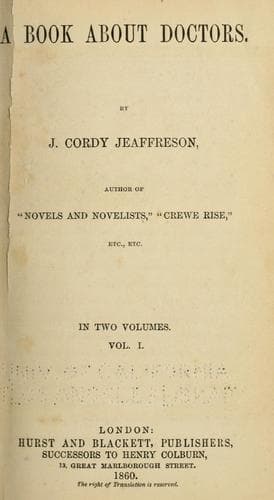
Medicine -- Anecdotes; Physicians -- Great Britain
Caius terminated his laborious and honourable career on July the 29th,
1573, in the sixty-third year of his age.[2] He was buried in his
college chapel, in a tomb constructed some time before his decease,
and marked with the brief epitaph--"Fui Caius." In the same year in
which this physician of Edward VI., Mary, and Elizabeth died, was born
Theodore Turquet de Mayerne, Baron Aulbone of France, and Sir Theodore
Mayerne in England. Of Mayerne mention will be made in various places
of these pages. There is some difficulty in ascertaining to how many
crowned heads this lucky courtier was appointed physician. After
leaving France and permanently fixing himself in England, he kept up
his connection with the French, so that the list of his
monarch-patients may be said to comprise two French and three English
sovereigns--Henry IV. and Louis XIII. of France, and James I., Charles
I., and Charles II. of England. Mayerne died at Chelsea, in the
eighty-second year of his age, on the 15th of March, 1655. Like John
Hunter, he was buried in the church of St. Martin's-in-the-Fields. His
library went to the College of Physicians, and his wealth to his only
daughter, who was married to the Marquis of Montpouvillon. Though
Mayerne was the most eminent physician of his time, his prescriptions
show that his enlightenment was not superior to the prevailing
ignorance of the period. He recommended a monthly excess of wine and
food as a fine stimulant to the system. His treatise on Gout, written
in French, and translated into English (1676) by Charles II.'s
physician in ordinary, Dr. Thomas Sherley, recommends a clumsy and
inordinate administration of violent drugs. Calomel he habitually
administered in scruple doses. Sugar of lead he mixed largely in his
conserves; pulverized human bones he was very fond of prescribing; and
the principal ingredient in his gout-powder was "raspings of a human
skull unburied." But his sweetest compound was his "Balsam of Bats,"
strongly recommended as an unguent for hypochondriacal persons, into
which entered adders, bats, suckling whelps, earth-worms, hog's
grease, the marrow of a stag, and the thigh-bone of an ox. After such
a specimen of the doctor's skill, possibly the reader will not care to
study his receipts for canine madness, communicated to the Royal
Society in 1687, or his "Excellent and well-approved Receipts and
Experiments in Cookery, with the best way of Preserving." Nor will the
reader be surprised to learn that the great physician had a firm
belief in the efficacy of amulets and charms.
[2] In Dr. Moussett's "Health's Improvement; or Rules concerning Food"
is a curious passage relating to this eminent physician's decay.
Public-domain text, read in full here on John Shaqi.
Reviews
Reviews
No reviews yet
Be the first to share your thoughts on this work.
Join the Discussion
Join the discussion
Sign in to leave a comment or review.
Sign InorCreate an account