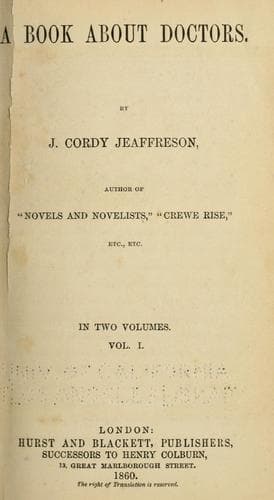
Medicine -- Anecdotes; Physicians -- Great Britain
The conclusion of Guyllyam's attendance is thus described:--"Trewe it
is this sycknesse that the kyng took in the voyage towards Bretagne
greatly abated the ioye of the realme of France, and good cause why,
for when the heed is sicke the body canne have no ioye. No man durste
openly speke thereof, but kepte it privy as moche as might be, and it
was couertly kept fro the queene, for tyll she was delyuered and
churched she knewe nothynge thereof, which tyme she had a doughter.
The physician, myster Guyllyam, who had the chefe charge of healynge
of the kynge, was styll aboute hym, and was ryght dyligent and well
acquyted hymselfe, whereby he gate bothe honour and profyte; for
lytell and lytell he brought the kynge in good estate, and toke away
the feuer and the heate, and made hym to haue taste and appetyte to
eate and drinke, slepe and rest, and knowledge of every thynge;
howebeit, he was very feble, and lytell and lytell he made the kynge
to ryde a huntynge and on hawkynge; and whanne tydynges was knowen
through France howe the kynge was well mended, and had his memory
again, every man was ioyfull and thanked God. The kynge thus beyng at
Crayell, desyred to se the quene his wyfe and the dolphyn his sonne;
so the quene came thyder to hym, and the chylde was brought thyder,
the kynge made them good chere, and so lytell and lytell, through the
helpe of God, the kynge recouered his helthe. And when mayster
Guyllyam sawe the kynge in so good case he was ryght ioyfull, as
reasone was, for he hade done a fayre cure, and so delyuered him to
the dukes of Orlyance, Berrey, Burgoyne, and Burbone, and sayd: 'My
lordes, thanked be God, the kynge is nowe in good state and helth, so
I delyuer him, but beware lette no mane dysplease hym, for as yet his
spyrytes be no fully ferme nor stable, but lytell and lytell he shall
waxe stronge; reasonable dysporte, rest, and myrthe shall be moste
profytable for hym; and trouble hym as lytell as may be with any
counsayles, for he hath been sharpely handeled with a hote malady.'
Than it was consydred to retaygne this mayster Guyllyam, and to gyve
hym that he shulde be content with all, _whiche is the ende that all
physicians requyre, to haue gyftes and rewardes_; he was desyred to
abyde styll about the kynge, but he excused hymselfe, and sayd howe he
was an olde impotent man, and coulde note endure the maner of courte,
wherfore he desyred to returne into his owne countrey. Whan the
counsayle sawe he wolde none otherwyse do, they gaue him leaue, and at
his departing _gave him a thousand crownes, and retayned hym in wages
with four horses whansover he wolde resorte to the courte_; howbeit, I
beleve he never came there after, for whan he retournd to the cytie of
Laon, there he contynued and dyed a ryche man: he left behynde him a
xxx thousand frankes. All his dayes he was one of the greatest
nygardes that ever was: all his pleasure was to get good and to spende
Public-domain text, read in full here on John Shaqi.
Reviews
Reviews
No reviews yet
Be the first to share your thoughts on this work.
Elsewhere in the archive
Join the Discussion
Join the discussion
Sign in to leave a comment or review.
Sign InorCreate an account