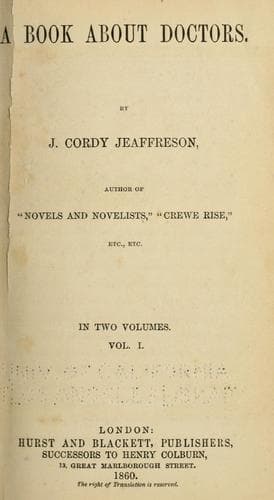
Medicine -- Anecdotes; Physicians -- Great Britain
nothynge, for in his howse he neuer spente past two souses of Parys
in a day, but wolde eate and drinke in other mennes howses, where as
he myght get it. _With this rodde lyghtly all physicyons are
beaten._"[19]
[19] Froissart's Chronicles, translated by John Bouchier, Lord
Berners.
The humane advice given by Guyllym countenances the tradition that
cards were invented for the amusement of his royal patient.
CHAPTER XII.
BLEEDING.
Fashion, capricious everywhere, is especially so in surgery and
medicine. Smoking we are now taught to regard as a pernicious
practice, to be abhorred as James the First abhorred it. Yet Dr.
Archer, and Dr. Everard in his "Panacea, or a Universal Medicine,
being a discovery of the wonderful virtues of Tobacco" (1659), warmly
defended the habit, and for long it was held by the highest
authorities to be an efficacious preservative against disease. What
would schoolboys now say to being flogged for _not_ smoking? Yet
Thomas Hearne, in his diary (1720-21) writes--"Jan. 21, I have been
told that in the last great plague in London none that kept
tobacconists' shops had the plague. It is certain that smoking was
looked upon as a most excellent preservative. In so much, that even
children were obliged to smoak. And I remember that I heard formerly
Tom Rogers, who was yeoman beadle, say, that when he was that year,
when the plague raged, a school-boy at Eton, all the boys of that
school were obliged to smoak in the school every morning, and that he
was never whipped so much in his life as he was one morning for not
smoaking."
Blood-letting, so long a popular remedy with physicians, has, like
tobacco-smoking for medicinal purposes, fallen into disuse and
contempt. From Hippocrates to Paracelsus, who, with characteristic
daring, raised some objections to the practice of venesection, doctors
were in the habit of drawing disease from the body as vintners extract
claret from a cask, in a ruddy stream. In the feudal ages bleeding was
in high favour. Most of the abbeys had a "flebotomaria" or
"bleeding-house," in which the sacred inmates underwent bleedings (or
"minutions" as they were termed) at stated periods of the year, to the
strains of psalmody. The brethren of the order of St. Victor underwent
five munitions annually--in September, before Advent, before Lent,
after Easter, and at Pentecost.
There is a good general view of the superstitions and customs
connected with venesection, in "The Salerne Schoole," a poem of which
mention continually occurs in the writings of our old physicians. The
poem commences with the following stanza:--
Public-domain text, read in full here on John Shaqi.
Reviews
Reviews
No reviews yet
Be the first to share your thoughts on this work.
Elsewhere in the archive
Join the Discussion
Join the discussion
Sign in to leave a comment or review.
Sign InorCreate an account