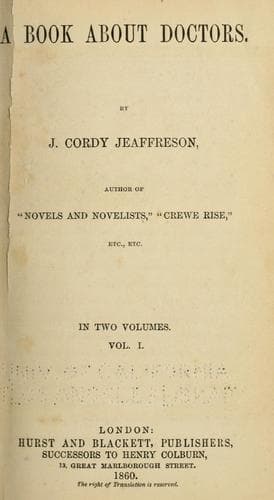
Medicine -- Anecdotes; Physicians -- Great Britain
But the sunshine did not come to Mead. He attracted it. Polished,
courtly, adroit, and of an equable temper, he seemed pleased with
everybody, and so made everybody pleased with him. Throughout life he
was a Whig--staunch and unswerving, notwithstanding the charges
brought against him by obscure enemies of being a luke-warm supporter
of the constitutional, and a subservient worshipper of the
monarchical, party. And yet his intimate friends were of the adverse
faction. The overbearing, insolent, prejudiced Radcliffe forgave him
his scholarship and politics, and did his utmost to advance his
interests.
Mead's family was a respectable one in Buckinghamshire. His father was
a theological writer, and one of the two ministers of Stepney, but was
ejected from his preferment for non-conformity on the 24th of August,
1662. Fortunately the dispossessed clerk had a private fortune on
which to maintain his fifteen children, of whom Richard, the eleventh,
was born on the eleventh of August, 1673. The first years of Richard's
life were spent at Stepney, where the Rev. Matthew Mead continued to
minister to a noncomformist congregation, keeping in house Mr. John
Nesbitt, afterwards a conspicuous nonconformist minister, as tutor to
his children. In 1683 or 1684, it being suspected that Mr. Mead was
concerned in certain designs against the government, the worthy man
had to quit his flock and escape from the emissaries of power to
Holland. During the father's residence abroad, Richard was sent to a
classical school kept in Clerkenwell Close, by the nonconformist,
Thomas Singleton, who had formerly been second master of Eton. It was
under this gentleman's tuition that the boy acquired a sound and
extensive knowledge of Latin and Greek. In 1690 he went to Utrecht;
and after studying there for three years, proceeded to Leyden, where
he studied botany and physic. His academical studies concluded, he
travelled with David Polhill and Dr. Thomas Pellet, afterwards
President of the College of Physicians, through Italy, stopping at
Florence, Padua, Naples, and Rome. In the middle of 1696 he returned
to London, with stores of information, refined manners, and a degree
of Doctor of Philosophy and Physic, conferred on him at Padua, on the
sixteenth of August, 1695. Settling at Stepney, and uniting himself
closely with the nonconformists, he commenced the practice of his
profession, in which he rapidly advanced to success. On the ninth of
May, 1703, before he was thirty years of age, he was chosen physician
of St. Thomas's Hospital, in Southwark. On obtaining this preferment
he took a house in Crutched Friars, and year by year increased the
sphere of his operations. In 1711 he moved to Austin Friars, to the
house just vacated by the death of Dr. Howe. The consequences of this
step taught him the value, to a rising doctor, of a house with a good
reputation. Many of Howe's patients had got into a habit of coming to
Public-domain text, read in full here on John Shaqi.
Reviews
Reviews
No reviews yet
Be the first to share your thoughts on this work.
Elsewhere in the archive
Join the Discussion
Join the discussion
Sign in to leave a comment or review.
Sign InorCreate an account