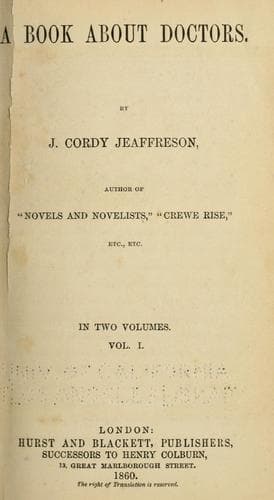
Medicine -- Anecdotes; Physicians -- Great Britain
the house as much as to the physician, and Mead was only too glad to
feel their pulses and flatter them into good humour, sound health, and
the laudable custom of paying double fees. He was appointed Lecturer
on Anatomy to the Company of Barbers and Surgeons.
He kept himself well before the public, as an author, with his
"Mechanical Account of Poisons," published in 1702; and his treatise
(1704), "De Imperio Solis et Lunæ in Corpora humana, et Morbis inde
oriundis." He became a member of the Royal Society; and, in 1707, he
received his M.D. diploma from Oxford, and his admission to the
fellowship of the College of Physicians.
It has already been stated how Radcliffe engaged to introduce Mead to
his patients. When Queen Anne was on her death-bed, the young
physician was of importance enough to be summoned to the couch of
dying royalty. The physicians who surrounded the expiring queen were
afraid to say what they all knew. The Jacobites wanted to gain time,
to push off the announcement of the queen's state to the last possible
moment, so that the Hanoverians should not be able to take steps for
quietly securing the succession which they desired. Mead, however, was
too earnest a Whig to sacrifice what he believed to be the true
interests of the country to any considerations of the private
advantage that might be derived by currying favour with the Tory
magnates, who, hovering about the Court, were debating how they could
best make their game. Possibly his hopes emboldened him to speak the
truth. Anyhow, he declared, on his first visit, that the queen would
not live an hour. Charles Ford, writing to Swift, said, "This morning
when I went there before nine, they told me she was just expiring.
That account continued above three hours, and a report was carried to
town that she was actually dead. She was not prayed for even in her
own chapel at St. James's; and, _what is more infamous (!)_ stocks
arose three _per cent._ upon it in the city. Before I came away, she
had recovered a warmth in her breast and one of her arms; and all the
doctors agreed she would, in all probability, hold out till
to-morrow--_except Mead, who pronounced, several hours before, she
could not live two minutes, and seems uneasy it did not happen so_."
This was the tone universally adopted by the Jacobites. According to
them, poor Queen Anne had hard measure dealt out to her by her
physicians;--the Tory Radcliffe negatively murdered her by not saving
her; the Whig Mead earnestly desired her death. Certainly the
Jacobites had no reason to speak well of Mead, for the ready courage
with which he stated the queen's demise to be at hand gave a
disastrous blow to their case, and did much to seat George I. quietly
on the throne. Miss Strickland observes, "It has always been
considered that the prompt boldness of this political physician (_i.
e._ Mead) occasioned the peaceable proclamation of George I. The
queen's demise in one hour was confidently predicted by her Whig
doctor.
Public-domain text, read in full here on John Shaqi.
Reviews
Reviews
No reviews yet
Be the first to share your thoughts on this work.
Elsewhere in the archive
Join the Discussion
Join the discussion
Sign in to leave a comment or review.
Sign InorCreate an account