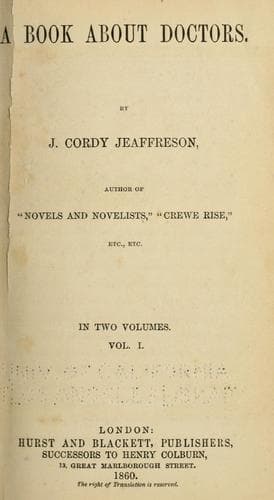
Medicine -- Anecdotes; Physicians -- Great Britain
It was on this principle that a belief became prevalent that certain
objects, either of natural formation or constructed by the instruments
of art, had the power of counteracting noxious agents. An intimate
connection was supposed to exist between the form or colour of an
external substance and the use to which it ought to be put. Red
objects had a mysterious influence on inflammatory diseases; and
yellow ones had a similar power on those who were discoloured with
jaundice. Edward II.'s physician, John of Gaddesden, informs us, "When
the son of the renowned King of England lay sick of the small-pox, I
took care that everything round the bed should be of a red colour,
which succeeded so completely that the Prince was restored to perfect
health without a vestige of a pustule remaining." Even as late as
1765, this was put in practice to the Emperor Francis I. The earliest
talismans were natural objects, with a more or less striking external
character, imagined to have been impressed upon them by the planets of
whose influence they were especially susceptible, and of whose virtues
they were beyond all other substances the recipients. The amulet
(which differs little from the talisman, save in that it must be
worn suspended upon the person it is to protect, whereas the talisman
might be kept by its fortunate possessor locked up in his
treasure-house) had a like origin.
But when once a superstitious regard was paid to the external marks of
a natural object, it was a short and easy step to produce the
semblances of the revered characters by an artificial process, and
then bestow on them the reverential feelings which had previously been
directed to their originals. The ordinary course taken by a
superstition in its degradation is one where its first sentiment
becomes lost to sight, and its form is dogmatically insisted on. It
was so in that phase of feticism which consisted in the blind reliance
put on artificial talismans and amulets. The original significance of
the talisman--the truth which was embodied in it as the emblem of the
unseen powers that had produced it, in accordance with natural
operations--was forgotten. The rows of lines and scratches, and the
variegations of its colour, were only thought of; and the cunning of
man--ever ready to make a god for himself--was exerted to improve upon
them. In the multitude of new devices came inscriptions of mystic
numbers, strange signs, agglomerations of figures, and scraps from
sacred rituals--Abraxas and Abracadabra, and the Fi-fo-fum nonsense of
the later charms.
Public-domain text, read in full here on John Shaqi.
Reviews
Reviews
No reviews yet
Be the first to share your thoughts on this work.
Elsewhere in the archive
Join the Discussion
Join the discussion
Sign in to leave a comment or review.
Sign InorCreate an account