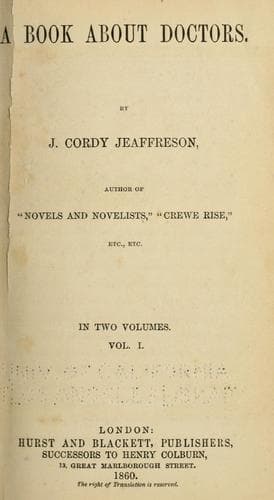
Medicine -- Anecdotes; Physicians -- Great Britain
Creatures that were capable of detecting the influence of the
planetary system on that portion of Nature which is unquestionably
affected by it, and of imagining its presence in inanimate objects,
which, to use cautious language, have never been proved by science to
be sensible of such a power, of course magnified its consequences in
all that related to the human intellect and character. The instant in
which a man entered the world was regarded as the one when he was most
susceptible. Indeed, a babe was looked upon as a piece of warm and
pliant wax: and the particular planet which was in the ascendant when
the nurse placed the new child of Adam amongst the people of earth
stamped upon it a distinctive charactery. To be born under a
particular star was then an expression that meant something. On the
nature of the star it depended whether homunculus, squealing out its
first agonies, was to be morose or gentle, patient or choleric, lively
or saturnine, amorous or vindictive--a warrior or a poet--a dreamer or
a man of action.
Laughing at the refinements of absurdity at which astrology had
arrived in his day, the author of "Hudibras" says:--
"There's but the twinkling of a star
Between a man of peace and war;
A thief and justice, fool and knave,
A huffing officer and slave;
A crafty lawyer and a pickpocket,
A great philosopher and a blockhead;
A formal preacher and a player,
A learned physician and manslayer.
As if men from stars did suck
Old age, diseases, and ill-luck,
Wit, folly, honour, virtue, vice,
Travel and women, trade and dice;
And draw, with the first air they breathe,
Battle and murder, sudden death.
Are not these fine commodities
To be imported from the skies,
And vended here amongst the rabble
For staple goods and warrantable?"
Involved in this view of the universe was the doctrine that some
exceptional individuals were born far superior to the mass of their
fellow-creatures. Absurd as astrology was, still, its postulates
having once been granted, the logic was unassailable which argued that
those few on whose birth lucky stars had shone benignantly, had a
destiny and an organization distinct from those of ordinary mortals.
The dicta of modern liberalism, and the Transatlantic dogma that "all
men are by nature born equal," would have appeared to an orthodox
believer in this planetary religion nothing better than the ravings of
madness or impiety. Monarchs of men, whatever lowly station they at
first occupied in life, were exalted above others because they
possessed a distinctive excellence imparted to them at the hour of
birth by the silent rulers of the night. It was useless to strive
against such authority. To contend with it would have been to wrestle
with the Almighty--ever present in his peculiarly favoured creatures.
Public-domain text, read in full here on John Shaqi.
Reviews
Reviews
No reviews yet
Be the first to share your thoughts on this work.
Elsewhere in the archive
Join the Discussion
Join the discussion
Sign in to leave a comment or review.
Sign InorCreate an account