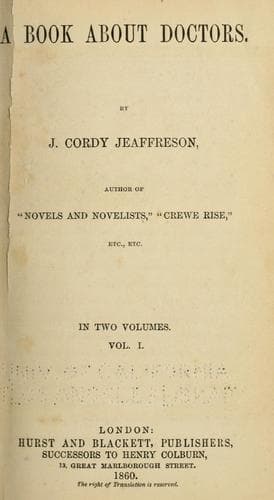
Medicine -- Anecdotes; Physicians -- Great Britain
Nor would it be wise to suppose that none were benefited by the
treatment. The eagerness with which the vulgar crowd to a sight, and
the intense excitement with which London mobs witness a royal
procession to the houses of Parliament, or a Lord Mayor's pageant on
its way from the City to Westminster, may afford us some idea of the
inspiriting sensations experienced by a troop of wretches taken from
their kennels to Whitehall, and brought into personal contact with
their sovereign--their ideal of grandeur! Such a trip was a stimulus
to the nervous system, compared with which the shock of a galvanic
battery would have been but the tickling of a feather. And, over and
above this, was the influence of imagination, which in many ways may
become an agent for restoring the tone of the nervous system, and so
enabling Nature to overcome the obstacles of her healthy action.
Montaigne admirably treated this subject in his essay, "Of the Force
of Imagination"; and his anecdote of the happy results derived by an
unfortunate nobleman from the use of a flat gold plate, graven with
celestial figures, must have occurred to many of his readers who have
witnessed the beneficial effects which are frequently produced by the
practices of quackery.
"These apes' tricks," says Montaigne, "are the main cause of the
effect, our fancy being so far seduced as to believe that such strange
and uncouth formalities must of necessity proceed from some abstruse
science. Their very inanity gives them reverence and weight."
And old Burton, touching, in his "Anatomy of Melancholy," on the
power of imagination, says, quaintly:--
"How can otherwise blear eyes in one man cause the like affection in
another? Why doth one man's yawning make another man yawn? Why do
witches and old women fascinate and bewitch children; but, as Wierus,
Paracelsus, Cardan, Migaldus, Valleriola, Cæsar Vanninus, Campanella,
and many philosophers think, the forcible imagination of one party
moves and alters the spirits of the other. Nay more, they cause and
cure, not only diseases, maladies, and several infirmities by this
means, as 'Avicenna de Anim. 1. 4, sect. 4,' supposeth in parties
remote, but move bodies from their places, cause thunder, lightning,
tempests; which opinion Alkindus, Paracelsus, and some others approve
of."
In this passage Burton touches not only on the effects of the
imagination, but also on the impression which the nervous energy of
one person may create upon the nervous sensibility of another. That
such an impression can be produced, no one can question who observes
the conduct of men in their ordinary relations to each other. By
whatever term we christen it--endeavouring to define either the cause
or its effect--we all concur in admitting that decision of character,
earnestness of manner, enthusiasm, a commanding aspect, a piercing
eye, or a strong will, exercise a manifest control over common
natures, whether they be acting separately or in masses.
Public-domain text, read in full here on John Shaqi.
Reviews
Reviews
No reviews yet
Be the first to share your thoughts on this work.
Elsewhere in the archive
Join the Discussion
Join the discussion
Sign in to leave a comment or review.
Sign InorCreate an account