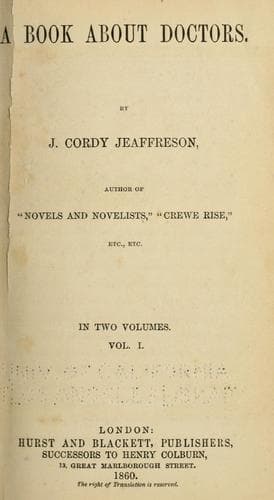
Medicine -- Anecdotes; Physicians -- Great Britain
Of the men who, without learning, or an ennobling passion for truth,
or a high purpose of any kind, have, unaided by physical force,
commanded the attention and directed the actions of large numbers of
their fellow creatures, Mesmer is perhaps the most remarkable in
modern history. But we will not speak of him till we have paid a few
minutes' attention to one of his predecessors.
The most notable forerunner of Mesmer in this country was Valentine
Greatrakes, who, in Charles the Second's reign, performed "severall
marvaillous cures by the stroaking of the hands." He was a gentleman
of condition, and, at first, the dupe of his own imagination rather
than a deliberate charlatan. He was born on the 14th of February,
1628, on his father's estate of Affane, in the County of Waterford,
and was, on both sides, of more than merely respectable extraction,
his father being a gentleman of good repute and property, and his
mother being a daughter of Sir Edward Harris, Knt, a Justice of the
King's Bench in Ireland. The first years of his school-life were
passed in the once famous Academy of Lismore; but when he had arrived
at thirteen years of age his mother (who had become a widow), on the
outbreak of the rebellion, fled with him and his little brothers and
sisters to England, where the fugitive family were hospitably
entertained by Mr. Edmund Harris, a gentleman of considerable
property, and one of the justice's sons. After concluding his
education in the family of one John Daniel Getseus, a High-German
minister of Stock Gabriel, in the County of Devon, Valentine returned
to Ireland, then distracted with tumult and armed rebellion; and, by
prudently joining the victorious side, re-entered on the possession of
his father's estate of Affane. He served for six years in Cromwell's
forces (from 1650 to 1656) as a lieutenant of the Munster Cavalry,
under the command of the Earl of Orrery. Valentine's commission was
in the earl's regiment; and, from the time of entering the army till
the close of his career is lost sight of, he seems to have enjoyed the
patronage and friendship of that nobleman's family.
Public-domain text, read in full here on John Shaqi.
Reviews
Reviews
No reviews yet
Be the first to share your thoughts on this work.
Elsewhere in the archive
Join the Discussion
Join the discussion
Sign in to leave a comment or review.
Sign InorCreate an account