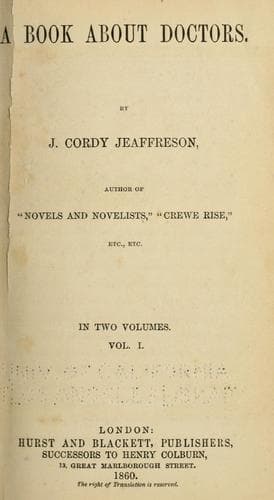
Medicine -- Anecdotes; Physicians -- Great Britain
"For in all times, in the opinion of the multitude, witches
and old women and impostors have had a competition with
physicians. And what followeth? Even this, that physicians
say to themselves, as Solomon expresseth it upon a higher
occasion, 'If it befall to me as befalleth to the fools, why
should I labour to be more wise?'"--Lord Bacon's
_Advancement of Learning_.
It is time to say something about the ladies as physicians. Once they
were the chief practitioners of medicine; and even to recent times had
a monopoly of that branch of art over which Dr. Locock presides. The
question has lately been agitated whether certain divisions of
remedial industry ought not again to be set aside for them; and the
patronage afforded to the lady who (in spite of the ridicule thrown on
her, and the rejection of her advances by various medical schools to
which she applied for admission as a student), managed to obtain a
course of medical instruction at one of the London schools, and
practised for a brief time in London previous to her departure for a
locality more suited to her operations, would seem to indicate that
public feeling is not averse to the thought of employing--under
certain conditions and for certain purposes--female physicians.
Of the many doctresses who have flourished in England during the last
200 years, only a few have left any memorial of their actions behind
them. Of _the wise women_ (a class of practitioners, by-the-by, still
to be found in many rural villages and in certain parts of London) in
whom our ancestors had as much confidence as we of the present
generation have in the members of the College of Physicians, we
question if twoscore, including Margaret Kennix and Mrs. Woodhouse, of
the Elizabethan era, could be rescued from oblivion. Some of them
wrote books, and so, by putting their names "in print," have a slight
hold on posthumous reputation. Two of them are immortalized by mention
in the records of the "Philosophical Transactions for 1694." These
ladies were Mrs. Sarah Hastings and Mrs. French. The curious may refer
to the account there given of the ladies' skill; and also, for further
particulars relative to Sarah Hastings, a glance may be given to M. de
la Cross's "Memoirs for the Ingenious," published in the month of
July, 1693. We do not care to transcribe the passages into our own
pages; though, now that it is the fashion to treat all the unpleasant
details of nursing as matters of romance, we presume there is nothing
in the cases mentioned calculated to shock public delicacy.
Public-domain text, read in full here on John Shaqi.
Reviews
Reviews
No reviews yet
Be the first to share your thoughts on this work.
Elsewhere in the archive
Join the Discussion
Join the discussion
Sign in to leave a comment or review.
Sign InorCreate an account