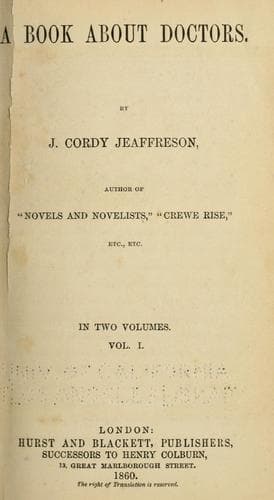
Medicine -- Anecdotes; Physicians -- Great Britain
Messenger Monsey, who used with a good deal of unnecessary noise to
declare his contempt of the ancestral honours which he in reality
possessed, loved to tell of the humble origin of his family. The first
Duke of Leeds delighted in boasting of his lucky progenitor, Jack
Osborn, the shop lad, who rescued his master's daughter from a watery
grave, in the Thames, and won her hand away from a host of noble
suitors, who wanted--literally, the young lady's _pin_-money. She was
the only child of a wealthy pinmaker carrying on his business on
London Bridge, and the jolly old fellow, instead of disdaining to
bestow his heiress on a 'prentice, exclaimed, "Jack won her, and he
shall wear her!" Dr. Monsey, in the hey-day of his social fame, told
his friends that the first of his ancestors of any note was a baker,
and a retail dealer in hops. At a critical point of this worthy man's
career, when hops were "down" and feathers were "up," to raise a small
sum of money for immediate use he ripped open his beds, sold the
feathers, and stuffed the tick with unsaleable hops. Soon a change in
the market occurred, and once more operating on the couches used by
himself and children, he sold the hops at a profit, and bought back
the feathers. "That's the way, sir, by which my family hopped from
obscurity!" the doctor would conclude.
We have reason for thinking that this ancestor was the physician's
great-grandfather. As is usually found to be the case, where a man
thinks lightly of the advantages of birth, Messenger was by no means
of despicable extraction. His grandfather was a man of considerable
property, and married Elizabeth Messenger, co-heir of Thomas
Messenger, lord of Whitwell Manor, in the county of Norfolk, a
gentleman by birth and position; and his father, the Rev. Robert
Monsey, a Norfolk rector, married Mary, the daughter of Roger Clopton,
rector of Downham. Of the antiquity and importance of the Cloptons
amongst the gentle families of England this is no place to speak; but
further particulars relative to the Monsey pedigree may be found by
the curious in Bloomfield's "History of Norfolk." On such a descent a
Celt would persuade himself that he represented kings and rulers.
Monsey, like Sydney Smith after him, preferred to cover the whole
question with jolly, manly ridicule, and put it out of sight.
Public-domain text, read in full here on John Shaqi.
Reviews
Reviews
No reviews yet
Be the first to share your thoughts on this work.
Elsewhere in the archive
Join the Discussion
Join the discussion
Sign in to leave a comment or review.
Sign InorCreate an account