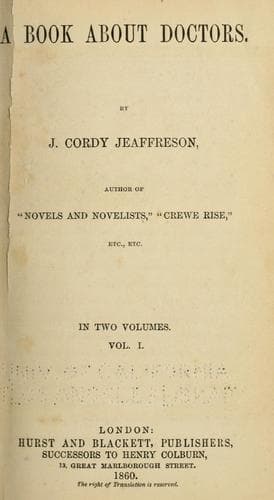
Medicine -- Anecdotes; Physicians -- Great Britain
Messenger Monsey was born in 1693, and received in early life an
excellent education; for though his father at the Revolution threw his
lot in with the nonjurors, and forfeited his living, the worthy
clergyman had a sufficient paternal estate to enable him to rear his
only child without any painful considerations of cost. After spending
five years at St. Mary's Hall, Cambridge, Messenger studied physic for
some time under Sir Benjamin Wrench, at Norwich. Starting on his own
account, he practised for a while at Bury St. Edmunds, in Suffolk, but
with little success. He worked hard, and yet never managed in that
prosperous and beautiful country town to earn more than three hundred
guineas in the same year. If we examined into the successes of medical
celebrities, we should find in a great majority of cases fortune was
won by the aspirant either annexing himself to, and gliding into the
confidence of, a powerful clique, or else by his being through some
lucky accident thrown in the way of a patron. Monsey's rise was of the
latter sort. He was still at Bury, with nothing before him but the
prospect of working all his days as a country doctor, when Lord
Godolphin, son of Queen Anne's Lord Treasurer, and grandson of the
great Duke of Marlborough, was seized, on the road to Newmarket, with
an attack of apoplexy. Bury was the nearest point where medical
assistance could be obtained. Monsey was summoned, and so fascinated
his patient with his conversational powers that his Lordship invited
him to London, and induced him to relinquish his country practice.
From that time Monsey's fortune was made. He became to the Whigs very
much what, in the previous generation, Radcliffe had been to the
Tories. Sir Robert Walpole genuinely loved him, seizing every
opportunity to enjoy his society, and never doing anything for him;
and Lord Chesterfield was amongst the most zealous trumpeters of his
medical skill. Lively, sagacious, well-read, and brutally sarcastic,
he had for a while a society reputation for wit scarcely inferior to
Swift's; and he lived amongst men well able to judge of wit. Garrick
and he were for many years intimate friends, until, in a contest of
jokes, each of the two brilliant men lost his temper, and they parted
like Roland and Sir Leoline--never to meet again. Garrick probably
would have kept his temper under any other form of ridicule, but he
never ceased to resent Monsey's reflection on his avarice to the
Bishop of Sodor and Man.
"Garrick is going to quit the stage," observed the Bishop.
"That he'll never do," answered Monsey, making use of a Norfolk
proverb, "so long as he knows a guinea is cross on one side and pile
on the other."
This speech was never forgiven. Lord Bath endeavoured to effect a
reconciliation between the divided friends, but his amiable intention
was of no avail.
"I thank you," said Monsey; "but why will your Lordship trouble
yourself with the squabbles of a Merry Andrew and quack doctor?"
Public-domain text, read in full here on John Shaqi.
Reviews
Reviews
No reviews yet
Be the first to share your thoughts on this work.
Elsewhere in the archive
Join the Discussion
Join the discussion
Sign in to leave a comment or review.
Sign InorCreate an account