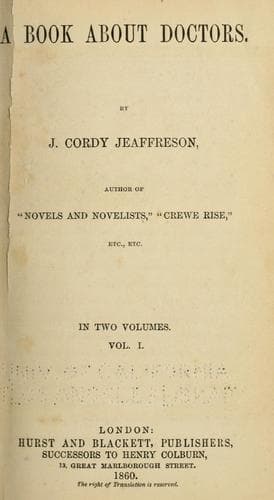
Medicine -- Anecdotes; Physicians -- Great Britain
When the tragedian was on his death-bed, Monsey composed a satire on
the sick man, renewing the attack on his parsimony. Garrick's illness,
however, terminating fatally, the doctor destroyed his verses, but
some scraps of them still remain to show their spirit and power. A
consultation of physicians was represented as being held over the
actor:--
"Seven wise physicians lately met,
To save a wretched sinner;
Come, Tom, said Jack, pray let's be quick,
Or I shall lose my dinner.
. . . . .
"Some roared for rhubarb, jalap some,
And some cried out for Dover;
Lets give him something, each man said--
Why e'en let's give him--over."
After much learned squabbling, one of the sages proposed to revive the
sinking energies of the poor man by jingling guineas in his ears. The
suggestion was acted upon, when--
"Soon as the fav'rite sound he heard,
One faint effort he try'd;
He op'd his eyes, he stretched his hands,
He made one grasp--and dy'd."
Though, on the grave closing over his antagonist, Monsey suppressed
these lines, he continued to cherish an animosity to the object of
them. The spirit in which, out of respect to death, he drew a period
to their quarrel, was much like that of the Irish peasant in the song,
who tells his ghostly adviser that he forgives Pat Malone with all his
heart (supposing death should get the better of him)--but should he
recover, he means to pay the rascal off roundly. Sir Walter Scott
somewhere tells a story of a Highland chief, in his last moments
declaring that he from the bottom of his heart forgave his old enemy,
the head of a hostile clan--and concluding this Christian avowal with
a final address to his son--"But may all evil light upon ye, Ronald,
if ye e'er forgie the heathen."
Through Lord Godolphin's interest, Monsey was appointed physician to
Chelsea College, on the death of Dr. Smart. For some time he continued
to reside in St. James's: but on the death of his patron he moved to
Chelsea, and spent the last years of his life in retirement--and to a
certain extent banishment--from the great world. The hospital offices
were then filled by a set of low-born scoundrels, or discharged
servants, whom the ministers of various Cabinets had had some reason
of their own for providing for. The surgeon was that Mr. Ranby who
positively died of rage because Henry Fielding's brother (Sir John)
would not punish a hackney coachman who had been guilty of the high
treason of--being injured and abused by the plaintiff. With this man
Monsey had a tremendous quarrel; but though in the right, he had to
submit to Ranby's powerful connections.
Public-domain text, read in full here on John Shaqi.
Reviews
Reviews
No reviews yet
Be the first to share your thoughts on this work.
Elsewhere in the archive
Join the Discussion
Join the discussion
Sign in to leave a comment or review.
Sign InorCreate an account