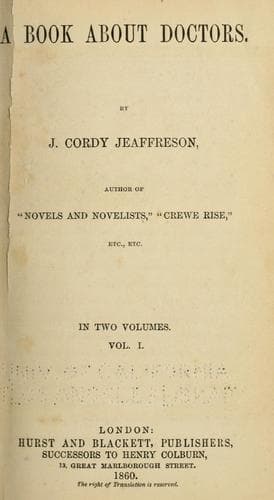
Medicine -- Anecdotes; Physicians -- Great Britain
"How do you stand this flabby weather? I tremble to hear,
but want to hear of all things. If you have done with my
stupid West India Ly., pray send 'em, for they go to-morrow
or next day at latest. 'Tis hardly worth while to trouble
Ld L with so much chaff and so little wheat--then why you!
"Very true. 'Tis a sad thing to have to do with a fool, who
can't keep his nonsense to himself. You know I am a rose,
but I have terrible prickles. Dear madam, adieu. Pray God I
may hear you are well, or that He will enable me to make you
so, for you must not be sick or die. I'll find fools and
rogues enough to be that for you, that are good for nothing
else, and hardly, very hardly, good enough for that. Adieu,
Adieu! I say Adieu, Adieu.
"M. M."
Truly did Dr. Messenger Monsey understand the art of writing a long
letter about nothing.
CHAPTER XVIII.
AKENSIDE.
There were two Akensides--Akenside the poet, and Akenside the man; and
of the _man_ Akenside there were numerous subdivisions. Remarkable as
a poet, he was even yet more noteworthy a private individual in his
extreme inconsistency. No character is more commonplace than the one
to which is ordinarily applied the word contradictory; but Akenside
was a curiosity from the extravagance in which this form of "the
commonplace" exhibited itself in his disposition and manners.
By turns he was placid, irritable, simple, affected, gracious,
haughty, magnanimous, mean, benevolent, harsh, and sometimes even
brutal. At times he was marked by a childlike docility, and at other
times his vanity and arrogance displayed him almost as a madman. Of
plebeian extraction, he was ashamed of his origin, and yet was
throughout life the champion of popular interests. Of his real
humanity there can be no doubt, and yet in his demeanour to the
unfortunate creatures whom, in his capacity of a hospital-physician,
he had to attend, he was always supercilious, and often cruel.
Like Byron, he was lame, one of his legs being shorter than the other;
and of this personal disfigurement he was even more sensitive than was
the author of "Childe Harold" of his deformity. When his eye fell on
it he would blush, for it reminded him of the ignoble condition in
which he was born. His father was a butcher at Newcastle-upon-Tyne;
and one of his cleavers, falling from the shop-block, had irremediably
injured the poet's foot, when he was still a little child.
Public-domain text, read in full here on John Shaqi.
Reviews
Reviews
No reviews yet
Be the first to share your thoughts on this work.
Elsewhere in the archive
Join the Discussion
Join the discussion
Sign in to leave a comment or review.
Sign InorCreate an account