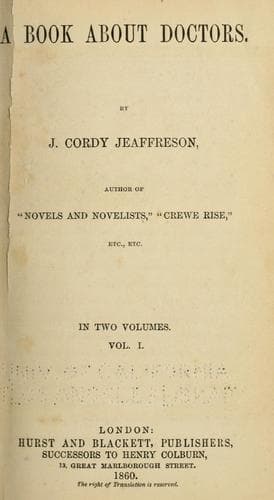
Medicine -- Anecdotes; Physicians -- Great Britain
Akenside was not only the son of a butcher--but, worse still, a
Nonconformist butcher; and from an early period of his life he was
destined to be a sectarian minister. In his nineteenth year he was
sent to Edinburgh to prosecute his theological studies, the expenses
of this educational course being in part defrayed by the Dissenters'
Society. But he speedily discovered that he had made a wrong start,
and persuaded his father to refund the money the Society had advanced,
and to be himself at the cost of educating him as a physician. The
honest tradesman was a liberal and affectionate parent. Mark remained
three years at Edinburgh, a member of the Medical Society, and an
industrious student. On leaving Edinburgh he practised for a short
time as a surgeon at Newcastle; after which he went to Leyden, and
having spent three months in that university took his degree of doctor
of physic, May 16, 1744. At Leyden he became warmly attached to a
fellow-student named Dyson; and wonderful to be related, the two
friends, notwithstanding one was under heavy pecuniary obligations to
the other, and they were very unlike each other in some of their
principal characteristics, played the part of Pylades and Orestes,
even into the Valley of Death. Akenside was poor, ardent, and of a
nervous, poetic temperament. Dyson was rich, sober, and
matter-of-fact, a prudent place-holder. He rose to be clerk of the
House of Commons, and a Lord of the Treasury; but the atmosphere of
political circles and the excitement of public life never caused his
heart to forget its early attachment. Whilst the poet lived Dyson was
his munificent patron, and when death had stepped in between them, his
literary executor. Indeed, he allowed him for years no less a sum than
£300 per annum.
Akenside was never very successful as a physician, although he
thoroughly understood his profession, and in some important
particulars advanced its science. Dyson introduced him into good
society, and recommended him to all his friends; but the greatest
income Akenside ever made was most probably less than what he obtained
from his friend's generosity. Still, he must have earned something,
for he managed to keep a carriage and pair of horses; and £300 per
annum, although a hundred years ago that sum went nearly twice as far
as it would now, could not have supported the equipage. His want of
patients can easily be accounted for. He was a vain, tempestuous,
crotchety little man, little qualified to override the prejudices
which vulgar and ignorant people cherish against lawyers and
physicians who have capacity and energy enough to distinguish
themselves in any way out of the ordinary track of their professional
duties.
Public-domain text, read in full here on John Shaqi.
Reviews
Reviews
No reviews yet
Be the first to share your thoughts on this work.
Elsewhere in the archive
Join the Discussion
Join the discussion
Sign in to leave a comment or review.
Sign InorCreate an account