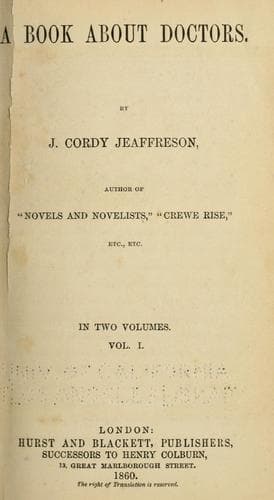
Medicine -- Anecdotes; Physicians -- Great Britain
The "Religio Medici" not only created an unprecedented sensation by
its erudition and polished style, but it shocked the nervous guardians
of orthodoxy by its boldness of inquiry. It was assailed for its
infidelity and scientific heresies. According to Coleridge's view of
the "Religio Medici," Sir Thomas Browne, "a fine mixture of humourist,
genius, and pedant," was a Spinosist without knowing it. "Had he,"
says the poet, "lived nowadays, he would probably have been a very
ingenious and bold infidel in his real opinions, though the kindness
of his nature would have kept him aloof from vulgar, prating,
obtrusive infidelity."
Amongst the adverse critics of the "Religio Medici" was the eccentric,
gallant, brave, credulous, persevering, frivolous, Sir Kenelm Digby. A
Mæcenas, a Sir Philip Sydney, a Dr. Dee, a Beau Fielding, and a Dr.
Kitchener, all in one, this man is chief of those extravagant
characters that astonish the world at rare intervals, and are found
nowhere except in actual life. No novelist of the most advanced
section of the idealistic school would dare to create such a personage
as Sir Kenelm. The eldest son of the ill-fated Sir Everard Digby, he
was scarcely three years old when his father atoned on the scaffold
for his share in the gunpowder treason. Fortunately a portion of the
family estate was entailed, so Sir Kenelm, although the offspring of
attainted blood, succeeded to an ample revenue of about £3000 a-year.
In 1618 (when only in his fifteenth year) he entered Gloucester Hall,
now Worcester College, Oxford. In 1621 he commenced foreign travel. He
attended Charles I. (then Prince of Wales) at the Court of Madrid; and
returning to England in 1623, was knighted by James I. at
Hinchinbroke, the house of Lord Montague, on the 23rd of October in
that year. From that period he was before the world as courtier, cook,
lover, warrior, alchemist, political intriguer, and man of letters. He
became a gentleman of the bedchamber, and commissioner of the navy. In
1628 he obtained a naval command, and made his brilliant expedition
against the Venetians and Algerians, whose galleys he routed off
Scanderon. This achievement is celebrated by his client and friend,
Ben Jonson:--
"Though, happy Muse, thou know my Digby well,
Yet read in him these lines: he doth excel
In honour, courtesy, and all the parts
Court can call hero, or man could call his arts.
He's prudent, valiant, just, and temperate;
In him all virtue is beheld in state;
And he is built like some imperial room
For that to dwell in, and be still at home.
His breast is a brave palace, a broad street,
Where all heroic, ample thoughts do meet;
Where nature such a large survey hath ta'en,
As other souls, to his, dwelt in a lane:
Witness his action done at Scanderoon
Upon his birthday, the eleventh of June."
Public-domain text, read in full here on John Shaqi.
Reviews
Reviews
No reviews yet
Be the first to share your thoughts on this work.
Join the Discussion
Join the discussion
Sign in to leave a comment or review.
Sign InorCreate an account