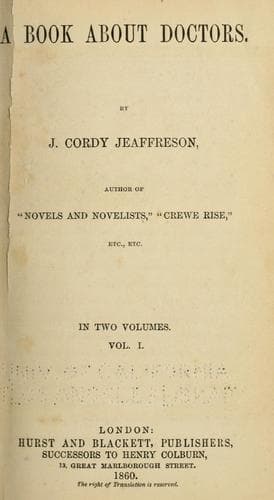
Medicine -- Anecdotes; Physicians -- Great Britain
Guy's hospital was the benevolent work of a London bookseller, who, by
perseverance, economy, and lucky speculation, amassed a very large
fortune. Thomas Guy began life with a stock of about £200, as a
stationery and bookseller in a little corner house between Cornhill
and Lombard-st., taking out his freedom of the Stationers' Company in
1668. He was a thrifty tradesman, but he won his wealth rather by
stock-jobbing than by the sale of books, although he made important
sums by his contract with the University of Oxford for their privilege
of printing bibles. Maitland informs us, "England being engaged in an
expensive war against France, the poor seamen on board the royal navy,
for many years, instead of money received tickets for their pay, which
those necessitous but very useful men were obliged to dispose of at
thirty, forty, and sometimes fifty in the hundred discount. Mr. Guy,
discovering the sweets of this traffick, became an early dealer
therein, as well as in other government securities, by which, and his
trade, he acquired a very great estate." In the South-sea stock he was
not less lucky. He bought largely at the outset, held on till the
bubble reached its full size, and ere the final burst sold out. It may
be questioned whether Guy's or Rahere's money was earned the more
honourably,--whether to fawn, flatter, and jest at the table of
princes was a meaner course of exertion than to drive a usurious trade
with poor sailors, and fatten on a stupendous national calamity. But
however basely it may have been gathered together, Guy's wealth was
well expended, in alleviating the miseries of the same classes from
whose sufferings it had been principally extracted. In his old age
Guy set about building his hospital, and ere his death, in 1724, saw
it completed. On its erection and endowment he expended £238,292
16_s._ 5_d._ To his honour it must be stated that, notwithstanding
this expenditure and his munificent contributions to other charities,
he had a considerable residue of property, which he distributed
amongst his poor relations.
Of the collegiate medical buildings of London, the one that belongs to
the humblest department of the profession is the oldest, and for that
reason--apart from its contents, which are comparatively of little
value--the most interesting. Apothecaries' Hall, in Water Lane,
Blackfriars, was built in 1670. Possibly the size and imposing aspect
of their college stimulated the drug-vendors to new encroachments on
the prescriptive and enacted rights of the physicians. The rancour of
"The Dispensary" passes over the merits (graces it has none) of the
structure, and designates it by mentioning its locality--
"Nigh where Fleet Ditch descends in sable streams,
To wash his sooty Naiads in the Thames,
There stands a structure on a rising hill,
Where tyros take their freedom out to kill."
Public-domain text, read in full here on John Shaqi.
Reviews
Reviews
No reviews yet
Be the first to share your thoughts on this work.
Elsewhere in the archive
Join the Discussion
Join the discussion
Sign in to leave a comment or review.
Sign InorCreate an account