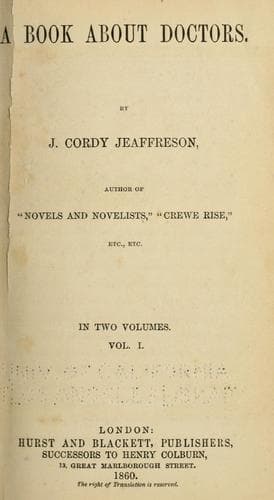
Medicine -- Anecdotes; Physicians -- Great Britain
Amongst the art-treasures of the hall are a portrait of James I. (who
first established the apothecaries as a company distinct from the
grocers), and a bust of Delaune, the lucky apothecary of that
monarch's queen, who has already been mentioned in these pages.
The elegant college of the physicians, in Pall Mall east, was not
taken into use till the 25th of June, 1825, the doctors migrating to
it from Warwick Hall, which is now in the occupation of the butchers
of Newgate Market. Had the predecessors of the present tenants been
"the surgeons," instead of "the physicians," the change of masters
would have given occasion for a joke. As it is, not even the
consolation of a jest can be extracted from the desecration of an
abode of learning that has many claims on our affection.
In "The Dispensary," the proximity of the college dome to the Old
Bailey is playfully pointed at:--
"Not far from that most celebrated place,
Where angry justice shows her awful face,
Where little villains must submit to fate,
That great ones may enjoy the world in state,
There stands a dome, majestic to the sight,
And sumptuous arches bear its oval height;
A golden globe, placed high with artful skill,
Seems, to the distant sight, a gilded pill:
This pile was, by the pious patron's aim,
Raised for a use as noble as its frame.
Nor did the learn'd society decline
The propagation of that great design;
In all her mazes, Nature's face they view'd,
And, as she disappear'd, their search pursued.
Wrapt in the shade of night, the goddess lies,
Yet to the learn'd unveils her dark disguise,
But shuns the gross access of vulgar eyes."
The Warwick Lane college was erected on the college at Amen Corner (to
which the physicians removed on quitting their original abode in
Knight-Rider Street), being burnt to the ground in the great fire of
1666. Charles II. and Sir John Cutler were ambitious of having their
names associated with the new edifice, the chief fault of which was
that, like all the other restorations following the memorable
conflagration, it was raised near the old site. Charles became its
pious patron, and Sir John Cutler its munificent benefactor. The
physicians duly thanked them, and honoured them with statues, Cutler's
effigy having inscribed beneath it, "Omnis Cutleri cedat labor
Amphitheatro."
So far, so good. The fun of the affair remains to be told. On Sir
John's death, his executors, Lord Radnor and Mr. Boulter, demanded of
the college £7000, which covered in amount a sum the college had
borrowed of their deceased benefactor, and also the sum he pretended
to have given. Eventually the executors lowered their claim to £2000
(which, it is reasonable to presume, had been _lent_ by Sir John), and
discontinued their demand for the £5000 given. Such being the stuff of
which Sir John was made, well might Pope exclaim:--
Public-domain text, read in full here on John Shaqi.
Reviews
Reviews
No reviews yet
Be the first to share your thoughts on this work.
Elsewhere in the archive
Join the Discussion
Join the discussion
Sign in to leave a comment or review.
Sign InorCreate an account