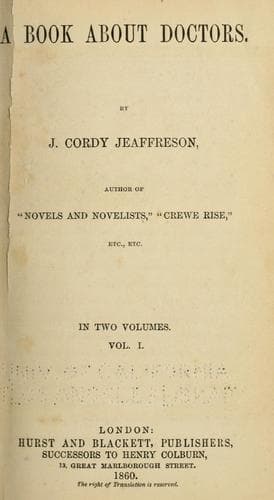
Medicine -- Anecdotes; Physicians -- Great Britain
"His Grace's fate sage Cutler could foresee,
And well (he thought) advised him, 'Live like me.'
As well his Grace replied, 'Like you, Sir John?
That I can do when all I have is gone.'"
In consideration of the £5000 retained of the niggard's money, the
physicians allowed his statue to remain, but they erased the
inscription from beneath it.
The Royal College of Surgeons in London was not incorporated till the
year 1800--more than half a century after the final disruption of the
surgeons from the barbers--and the college in Lincoln's Inn Fields was
not erected till 1835. Its noble museum, based on the Hunterian
Collection, which the nation purchased for £15,000, contains, amongst
its treasures, a few preparations that are valuable for their
historical associations or sheer eccentricity, rather than for any
worth from a strictly scientific point of view. Amongst them are
Martin Van Buchell's first wife, whose embalmment by William Hunter
has already been mentioned; the intestines of Napoleon, showing the
progress of the disease which was eventually fatal to him; and the
fore-arms (preserved in spirits) of Thomas Beaufort, third son of John
of Gaunt, Duke of Lancaster.
The writer had recently submitted to his notice, by Dr. Diamond of
Twickenham, a very interesting and beautifully penned manuscript,
relating to these remains, of which the following is a copy:--
"BURY ST EDMUNDS.
"_Joseph Pater scripsit, when thirteen years of age._
"On the 20th of February, 1772, some labourers, employed in breaking
up part of the old abbey church, discovered a leaden coffin, which
contained an embalmed body, as perfect and entire as at the time of
its death; the features and lineaments of the face were perfect, which
were covered with a mask of embalming materials. The very colour of
the eyes distinguishable; the hairs of the head a brown, intermixed
with some few gray ones; the nails fast upon the fingers and toes as
when living; stature of the body about six feet tall, and genteelly
formed. The labourers, for the sake of the lead (which they sold to Mr
Faye, a plummer, in this town, for about 15s), stript the body of its
coffin, and threw it promiscuously amongst the rubbish. From the place
of its interment it was soon found to be the remains of Thomas
Beaufort, third son of John de Gaunt, Duke of Lancaster, by his third
duchess, Lady Catherine Swineford, relict of Sir Otho de Swineford, of
Lincolnshire. He took the name of Beaufort from the place of his
birth, a castle of the duke's, in France. He was half-brother to King
Henry IV., created Duke of Exeter and Knight of the Garter; in 1410,
Lord Chancellor of England; in 1412, High Admiral of England, and
Captain of Calais; he commanded the Rear-Guard of his nephew King
Henry the Fifth's army at the battle of Agincourt, on the 25th of
October, 1415; and in 1422, upon the death of King Henry the Fifth,
Public-domain text, read in full here on John Shaqi.
Reviews
Reviews
No reviews yet
Be the first to share your thoughts on this work.
Elsewhere in the archive
Join the Discussion
Join the discussion
Sign in to leave a comment or review.
Sign InorCreate an account