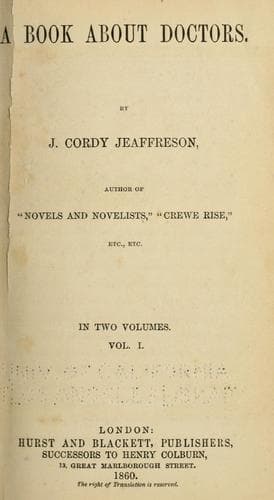
Medicine -- Anecdotes; Physicians -- Great Britain
Of the country doctors of the middle and close of the last century,
Dr. Slop is a fair specimen. They were a rude, vulgar, keen-witted set
of men, possessing much the same sort of intelligence, and disfigured
by the same kind of ignorance, as a country gentleman expects now to
find in his farrier. They had to do battle with the village nurses at
the best on equal terms, often at a disadvantage; masculine dignity
and superior medical erudition being in many districts of less account
than the force of old usage, and the sense of decorum that supported
the lady practitioners. Mrs. Shandy had an express provision in her
marriage settlement, securing her from the ignorance of country
doctors. Of course, in respect to learning and personal acquirements,
the rural practitioners, as a class, varied very much, in accordance
with the intelligence and culture of the district in which their days
were spent, with the class and character of their patients, and with
their own connections and original social condition. On his Yorkshire
living Sterne came in contact with a rought lot. The Whitworth Taylors
were captains and leaders of the army in which Dr. Slop was a
private. The original of the last-mentioned worthy was so ill-read
that he mistook Lithopædii Senonensis Icon for the name of a
distinguished surgical authority, and, under this erroneous
impression, quoted Lithopædus Senonensis with the extreme of gravity.
This Lithopædus Senonensis story is not without its companions. A
prescription, in which a physician ordered _extract, rad valer._, and
immediately under it, as an ingredient in the same mixture, a certain
quantity of _tinctura ejusdem_, sorely perplexed the poor apothecary
to who it was sent to be dispensed. _Tinctura ejusdem!_ What could it
be! _Ejusdem!_ In the whole pharmacopoeia such a drug was not named.
Nothing like it was to be found on any label in his shop. At his wits'
end, the poor fellow went out to a professional neighbour, and asked,
in an off-hand way, "How are you off for _Tinctura Ejusdem_? I am out
of it. So can you let me have a little of yours." The neighbour, who
was a sufficiently good classical scholar to have _idem_, _eadem_,
_idem_ at his tongue's end, lamented that he too was "out of the
article." and sympathizingly advised his _confrère_, without loss of
time, to apply for some at Apothecaries' Hall. What a delightful
blunder to make to a _friend_, of all the people in the world! The
apothecary must have been a dull as well as an unlettered fellow, or
he would have known the first great rule of his art--"When in
doubt--_Use water!_" A more awkward mistake still was that made by the
young dispenser, who, for the first time in his life, saw at the end
of a prescription the words _pro re natâ_. What could they mean? _pro
re natâ!_ What could _pro re natâ_ have to do with a mixture sent to
a lady who had just presented her husband with an heir. With the aid
Public-domain text, read in full here on John Shaqi.
Reviews
Reviews
No reviews yet
Be the first to share your thoughts on this work.
Elsewhere in the archive
Join the Discussion
Join the discussion
Sign in to leave a comment or review.
Sign InorCreate an account