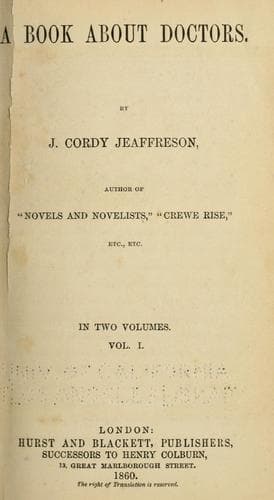
Medicine -- Anecdotes; Physicians -- Great Britain
of a Latin Dictionary, the novice rendered _pro re natâ_ "for the
thing born." Of course. Clearly the mixture was for the baby. And in a
trice the compound to be taken by an adult, as circumstances should
indicate a necessity for a dose, was sent off for the "little
stranger."
May not mention here be made of thee, ancient friend of childhood,
Roland Trevor? The whole country round, for a circle of which the
diameter measured thirty fair miles, thou wert one of the most popular
doctors of East Anglia. Who rode better horses? Who was the bolder in
the hunt, or more joyous over the bottle? Cheery of voice, with hearty
laughter rolling from purple lips, what company thou wert to festive
squires! The grave some score years since closed over thee, when
ninety-six years had passed over thy head--covering it with silver
tresses, and robbing the eye of its pristine fire, and the lip of its
mirthful curl. The shop of a country apothecary had been thy only
_Alma Mater_; so, surely, it was no fault of thine if thy learning was
scanty. Still, in the pleasant vales of Loes and Wilford is told the
story of how, on being asked if thou wert a believer in _phrenology_,
thou didst answer with becoming gravity, "I never keep it, and I never
use it. But I think it highly probable that, given frequently and in
liberal doses, it would be very useful in certain cases of irregular
gout."
Another memory arises of a country doctor of the old school. A huge,
burly, surly, churlish old fellow was Dr. Standish. He died in
extremely advanced age, having lived twenty-five years in the present
century. A ferocious radical, he was an object of considerable public
interest during the period of political excitement consequent on the
French Revolution. Tom Paine, the Thetford breeches-maker of whom the
world has heard a little, was his familiar friend and correspondent.
It was rumoured throughout the land that "government" had marked the
doctor out for destruction.
"Thar sai," the humbler Suffolk farmers used to gossip amongst
themselves, "thar sai a picter-taikin chap hav guv his poortright to
the King. And Billy Pitt ha'sin it. And oold King Georgie ha' swaren
as how that sooner nor later he'll hav his hid" (_i. e._ head).
The "upper ten" of Holmnook, and the upper ten-times-ten of the
distance round about Holmnook, held themselves aloof from such a
dangerous character. But the common folk believed in and admired him.
There was something of romance about a man whom George III. and Billy
Pitt were banded together to destroy.
Standish was a man of few words. "Down with the bishops!" "Up with the
people!" were his stock sentiments. He never approached nearer poetry
than when (yellow being then the colour of the extreme liberal party
in his district) he swore "there worn't a flower in the who' o'
crashun warth lookin' at but a sunflower, for that was yallow, and a
big un."
Public-domain text, read in full here on John Shaqi.
Reviews
Reviews
No reviews yet
Be the first to share your thoughts on this work.
Elsewhere in the archive
Join the Discussion
Join the discussion
Sign in to leave a comment or review.
Sign InorCreate an account