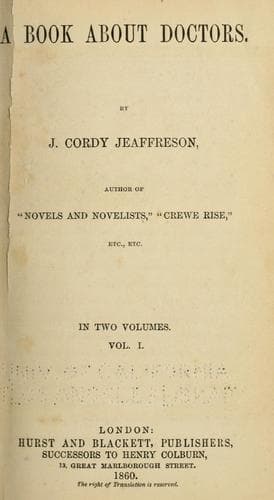
Medicine -- Anecdotes; Physicians -- Great Britain
The lives of three physicians--Sydenham, Sir Hans Sloane, and
Heberden--completely bridge over the uncertain period between old
empiricism and modern science. The son of a wealthy Dorsetshire
squire, Sydenham was born in 1624, and received the most important
part of his education in the University of Oxford, where he was
created Bachelor of Medicine 14th April, 1648. Settling in London
about 1661, he was admitted a Licentiate of the Royal College of
Physicians 25th June, 1665. Subsequently he acquired an M.D. degree at
Cambridge, but this step he did not take till 17th May, 1676. He also
studied physic at Montpellier; but it may be questioned if his
professional success was a consequence of his labours in any seat of
learning, so much as a result of that knowledge of the world which he
gained in the Civil war as a captain in the Parliamentary army. It was
he who replied to Sir Richard Blackmore's inquiry after the best
course of study for a medical student to pursue--"Read Don Quixote; it
is a very good book--I read it still." Medical critics have felt it
incumbent on themselves to explain away this memorable answer--attributing
it to the doctor's cynical temper rather than his scepticism with
regard to medicine. When, however, the state of medical science in the
seventeenth century is considered, one has not much difficulty in
believing that the shrewd physician meant exactly what he said. There
is no question but that as a practitioner he was a man of many doubts.
The author of the capital sketch of Sydenham in the "Lives of British
Physicians" says--"At the commencement of his professional life it is
handed down to us by tradition, that it was his ordinary custom, when
consulted by his patients for the first time, to hear attentively the
story of their complaints, and then say, 'Well, I will consider of
your case, and in a few days will order something for you.' But he
soon discovered that this deliberate method of proceeding was not
satisfactory, and that many of the persons so received forgot to come
again; and he was consequently obliged to adopt the usual practice of
prescribing immediately for the diseases of those who sought his
advice." A doctor who feels the need for such deliberation must labour
under considerable perplexity as to the proper treatment of his
patient. But the low opinion he expressed to Blackmore of books as
instructors in medicine, he gave publicly with greater decorum, but
almost as forcibly, in a dedication addressed to Dr. Mapletoft, where
he says, "The medical art could not be learned so well and so surely
as by use and experience; and that he who would pay the nicest and
most accurate attention to the symptoms of distempers would succeed
best in finding out the true means of cure."
Public-domain text, read in full here on John Shaqi.
Reviews
Reviews
No reviews yet
Be the first to share your thoughts on this work.
Join the Discussion
Join the discussion
Sign in to leave a comment or review.
Sign InorCreate an account