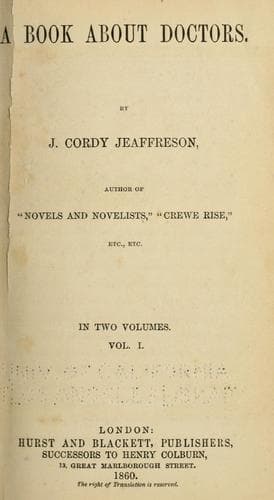
Medicine -- Anecdotes; Physicians -- Great Britain
Hans Sloane (the seventh and youngest child of Alexander Sloane,
receiver-general of taxes for the county of Down, before and after the
Civil war, and a commissioner of array, after the restoration of
Charles II.) was born at Killileagh in 1660. An Irishman by birth, and
a Scotchman by descent, he exhibited in no ordinary degree the energy
and politeness of either of the sister countries. After a childhood of
extreme delicacy he came to England, and devoted himself to medical
study and scientific investigation. Having passed through a course of
careful labour in London, he visited Paris and Montpellier, and,
returning from the Continent, became the intimate friend of Sydenham.
On the 21st of January, 1685, he was elected a Fellow of the Royal
Society; and on the 12th of April, 1687, he became a Fellow of the
College of Physicians. In the September of the latter year he sailed
to the West Indies, in the character of physician to the Duke of
Albemarle, who had been appointed Governor of Jamaica. His residence
in that quarter of the globe was not of long duration. On the death of
his Grace the doctor attended the Duchess back to England, arriving
once more in London in the July of 1689. From that time he remained in
the capital--his professional career, his social position, and his
scientific reputation being alike brilliant. From 1694 to 1730, he was
a physician of Christ's Hospital. On the 30th of November, 1693, he
was elected Secretary of the Royal Society. In 1701 he was made an
M.D. of Oxford; and in 1705 he was elected into the fellowship of the
College of Physicians of Edinburgh. In 1708 he was chosen a Fellow of
the Royal Academy of Sciences of Paris. Four years later he was
elected a member of the Royal Society of Berlin. In 1719 he became
president of the College of Physicians; and in 1727 he was created
President of the Royal Society (on the death of Sir Isaac Newton), and
was appointed physician to King George II. In addition to these
honours, he won the distinction of being the first[6] medical
practitioner advanced to the dignity of a baronetcy.
Public-domain text, read in full here on John Shaqi.
Reviews
Reviews
No reviews yet
Be the first to share your thoughts on this work.
Join the Discussion
Join the discussion
Sign in to leave a comment or review.
Sign InorCreate an account