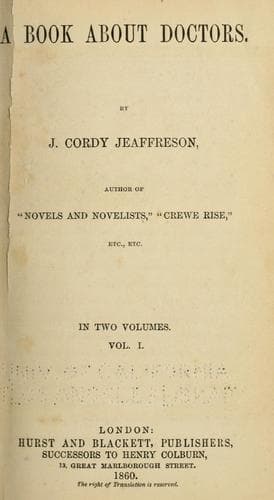
Medicine -- Anecdotes; Physicians -- Great Britain
On passing (in 1809) through the galleries of the Louvre, he could
find nothing more worthy of admiration than the fine frames of the
pictures. "What an extraordinary collection of fine frames!" he
observed to the gentleman who acted as his guide, amidst the treasures
of art gathered from every part of the Continent. His attention was
directed to the "Transfiguration"; when, on its being suggested to him
that he was looking at a rather well-executed picture, he said,
coldly, "Indeed! I am glad I have seen it." In the same way, the
statues were to him simply blocks of material. In the Apollo
Belvidere, the Laocoon, and the Venus dei Medici, he saw no beauty;
but when his eyes rested on the Antinous, treated in the Egyptian
style, and sculptured in alabaster, he made an exclamation of delight,
and cried, "Gracious powers, what a beautiful stalactite!"
More amusing than even these criticisms, is a story told of Lady Davy,
who accompanied her husband to Paris. She was walking in the Tuileries
garden, wearing the fashionable London bonnet of the day--shaped like
a cockle-shell. The Parisians, who just then were patronizing bonnets
of enormous dimensions, were astounded at the apparition of a
head-dress so opposed to their notions of the everlasting fitness of
things; and with the good breeding for which they are and have long
been proverbial, they surrounded the daring stranger, and stared at
her. This was sufficiently unpleasant to a timid English lady. But her
discomfort had only commenced. Ere another minute or two had elapsed,
one of the inspectors of the garden approached, and telling her
Ladyship that no cause of _rassemblement_ could be permitted in that
locality, requested her to retire. Alarmed and indignant, she appealed
to some officers of the Imperial Guard, but they could afford her no
assistance. One of them politely offered her his arm, and proposed to
conduct her to a carriage. But by the time she had decided to profit
by the courtesy, such a crowd had gathered together, that it was found
necessary to send for a guard of infantry, and remove _la belle
Anglaise_, surrounded with bayonets.
CHAPTER V.
THE APOTHECARIES AND SIR SAMUEL GARTH.
Baldwin Hamey, whose manuscript memoirs of eminent physicians are
among the treasures of the College, praises Winston because he treated
his apothecary as a master might a slave. "Heriliter imperavit," says
the Doctor. The learned Thomas Winston, anatomy lecturer at Gresham
College, lived to the age of eighty years, and died on the 24th of
October, 1655. He knew, therefore, apothecaries in the day of their
humility--before prosperity had encouraged them to compete with their
professional superiors.
Public-domain text, read in full here on John Shaqi.
Reviews
Reviews
No reviews yet
Be the first to share your thoughts on this work.
Join the Discussion
Join the discussion
Sign in to leave a comment or review.
Sign InorCreate an account