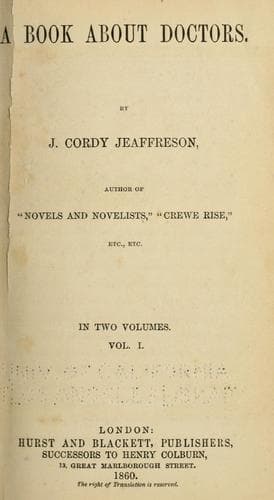
Medicine -- Anecdotes; Physicians -- Great Britain
This measure of the College was impolitic and unjustifiable. It was
unjust to that important division of the trade who were ready to vend
the medicines at rates to be fixed by the College authorities--for it
took altogether out of their hands the small amount of profit which
they, as _dealers_, could have realized on those terms. It was also an
eminently unwise course. The College sank to the level of the
Apothecaries' Hall, becoming an emporium for the sale of medicines.
It was all very well to say that no profit was made on such sale--the
censorious world would not believe it. The apothecaries and their
friends denied that such was the fact, and avowed that the benevolent
dispensarians were bent only on underselling and ruining them.
Again, the movement introduced dissension within the walls of the
College. Many of the first physicians, with the conservatism of
success, did not care to offend the apothecaries, who were continually
calling them in, and paying them fees. They therefore joined in the
cry against the dispensary. The profession was split up into
dispensarians and anti-dispensarians. The apothecaries combined and
agreed not to recommend the dispensarians. The anti-dispensarians
repaid this ill service by refusing to meet dispensarians in
consultation. Sir Thomas Millington, the president of the College,
Edward Hulse, Hans Sloane, John Woodward, Sir Edmund King, and Samuel
Garth were amongst the latter. Of them the last-named was the man who
rendered the most efficient service to his party.
Garth is perhaps the most cherished by the present generation of all
the physicians of Pope's time. He was a Whig without rancour, and a
bon-vivant without selfishness. Full of jest and amiability, he did
more to create merriment at the Kit-Kat club than either Swift or
Arbuthnot. He loved wine to excess; but then wine loved him too,
ripening and warming his wit, and leaving no sluggish humour behind.
His practice was a good one, but his numerous patients prized his
_bon-mots_ more than his prescriptions. His enemies averred that he
was not only an epicure, but a profligate voluptuary and an infidel.
Pope, however, wrote of him after his death, "If ever there was a good
Christian, without knowing himself to be so, it was Dr. Garth." Pope
had honoured him when alive by dedicating his second pastoral to him.
"Accept, O Garth, the muse's early lays,
That adds this wreath of ivy to thy bays;
Hear what from love unpractised hearts endure,
From love, the sole disease thou canst not cure."
Public-domain text, read in full here on John Shaqi.
Reviews
Reviews
No reviews yet
Be the first to share your thoughts on this work.
Join the Discussion
Join the discussion
Sign in to leave a comment or review.
Sign InorCreate an account