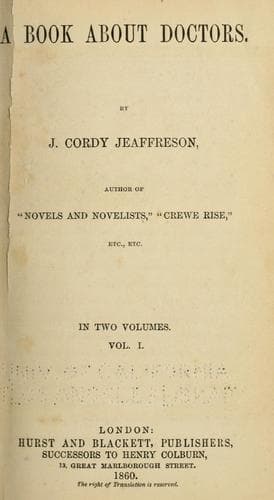
Medicine -- Anecdotes; Physicians -- Great Britain
In the feudal ages medicine and quackery were the same, as far as any
principles of science are concerned. The only difference between the
physician and the charlatan was, that the former was a fool and the
latter a rogue. Men did not meddle much with the healing art. A few
clerks devoted themselves to it, and in the exercise of their
spiritual and medical functions discovered how to get two fleeces from
a sheep at one shearing; but the care of the sick was for the most
part left to the women, who then, as in every other period of the
world's history, prided themselves on their medical cunning, and, with
the exception of intrigue, preferred attending on the sick to any
other occupation. From the time of the Reformation, however, the
number of lady doctors rapidly diminished. The fair sex gradually
relinquished the ground they had so long occupied, to men, who, had
the monastic institutions continued to exist, would have assumed the
priestly garb and passed their days in sloth. Quackery was at length
fairly taken out of the hands of women and the shelter of domestic
life, and was practised, not for love, and in a superstitious belief
in its efficacy, but for money, and frequently with a perfect
knowledge of its worthlessness as a remedial system.
As soon as the printing-press had become an institution of the
country, and there existed a considerable proportion of the community
capable of reading, the empirics seized hold of Caxton's invention,
and made it subservient to their honourable ends. The advertising
system was had recourse to in London, during the Stuart era, scarcely
less than it is now. Handbills were distributed in all directions by
half-starved wretches, whose withered forms and pallid cheeks were of
themselves a sufficient disproof of the assertions of their employers.
The costume, language, style, and artifices of the pretenders to
physic in the seventeenth century were doubtless copied from models of
long standing, and differed little in essentials from those of their
predecessors. Professions retain their characteristics with singular
obstinacy. The doctor of Charles the Second's London transmitted all
his most salient features to the quack of the Regency.
Cotgrave, in his "Treasury of "Wit and Language," published 1655, thus
paints the poor physician of his time:--
Public-domain text, read in full here on John Shaqi.
Reviews
Reviews
No reviews yet
Be the first to share your thoughts on this work.
Join the Discussion
Join the discussion
Sign in to leave a comment or review.
Sign InorCreate an account