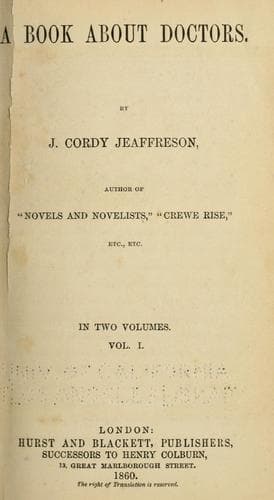
Medicine -- Anecdotes; Physicians -- Great Britain
wealth from the king of Mesopotamia, who wanted him to accept a
fortune of a thousand gold pieces a month, tarry with the
Mesopotamians, and keep them out of Death's clutches. Sometimes this
harangue was made from the back of a horse; sometimes from a rude
hustings, from which he was called _mountebank_. He sold all kinds of
medicaments: dyes for the hair, washes for the complexion, lotions to
keep young men youthful; rings which, when worn on the fore-finger of
the right hand, should make a chosen favourite desperately in love
with the wearer, and when worn on the same finger of the left hand,
should drive the said favourite to commit suicide. Nothing could
surpass the impudence of the fellow's lies, save the admiration with
which his credulous auditors swallowed his assertions. There they
stood,--stout yeomen, drunken squires, merry peasant girls, gawky
hinds, gabbling dames, deeming themselves in luck's way to have lived
to see such a miracle of learning. Possibly a young student home from
Oxford, with the rashness of inexperience, would smile scornfully, and
in a loud voice designate the pretender a quack--a quacksalvar
(kwabzalver), from the liniment he vended for the cure of wens. But
such an interruption, in ninety and nine cases out of every hundred,
was condemned by the orthodox friends of the young student, and he
was warned that he would come to no good if he went on as he had
begun--a contemptuous unbeliever, and a mocker of wise men.
The author of the "Discourse de l'Origine des Mœurs, Fraudes, et
Impostures des Ciarlatans, avec leur Découverte, Paris, 1662," says,
"Premièrement, par ce mot de Ciarlatans, j'entens ceux que les
Italiens appellent Saltambaci, basteleurs, bouffons, vendeurs de
bagatelles, et generalement toute autre personne, laquelle en place
publique montée en banc, à terre, ou à cheval, vend medecines, baumes,
huilles ou poudres, composées pour guerir quelque infirmité, louant et
exaltant sa drogue, avec artifice, et mille faux sermens, en racontant
mille et mille merveilles.
* * * * *
"Mais c'est chose plaisante de voir l'artifice dont se servent ces
medecins de banc pour vendre leur drogue, quand avec mille faux
sermens ils affirment d'avoir appris leur secret du roi de Dannemarc,
au d'un prince de Transilvanie."
The great quack of Charles the Second's London was Dr. Thomas Saffold.
This man (who was originally a weaver) professed to cure every disease
of the human body, and also to foretell the destinies of his patients.
Along Cheapside, Fleet-street, and the Strand, even down to the sacred
precincts of Whitehall and St. James's, he stationed bill-distributors,
who showered prose and poetry on the passers-by--just as the agents
(possibly the poets) of the Messrs. Moses cast their literature on the
town of Queen Victoria. When this great benefactor of his species
departed this life, on May the 12th, 1691, a satirical broadsheet
called on the world to mourn for the loss of one--
Public-domain text, read in full here on John Shaqi.
Reviews
Reviews
No reviews yet
Be the first to share your thoughts on this work.
Join the Discussion
Join the discussion
Sign in to leave a comment or review.
Sign InorCreate an account