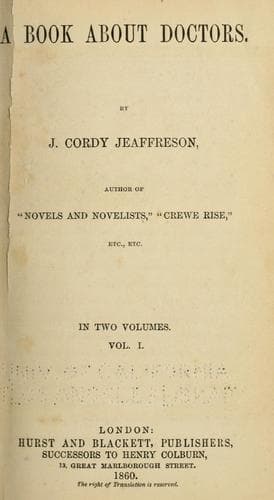
Medicine -- Anecdotes; Physicians -- Great Britain
Queen Anne's weak eyes caused her to pass from one empiric to another,
for the relief they all promised to give, and in some cases even
persuaded that they gave her. She had a passion for quack oculists;
and happy was the advertising scoundrel who gained her Majesty's
favour with a new collyrium. For, of course, if the greatest personage
in the land said that Professor Bungalo was a wonderful man, a master
of his art, and inspired by God to heal the sick, there was no appeal
from so eminent an authority. How should an elderly lady with a crown
on her head be mistaken? Do we not hear the same arguments every day
in our own enlightened generation, when the new Chiropodist, or
Rubber, or inventor of a specific for consumption, points to the
social distinctions of his dupes as conclusive evidence that he is
neither supported by vulgar ignorance, nor afraid to meet the most
searching scrutiny of the educated? Good Queen Anne was so charmed
with two of the many knaves who by turns enjoyed her countenance, that
she had them sworn in as her own oculists in ordinary; and one of them
she was even so silly as to knight. This lucky gentleman was William
Reade, originally a botching tailor, and to the last a very ignorant
man, as his "Short and Exact Account of all Diseases Incident to the
Eyes" attests; yet he rose to the honour of knighthood, and the most
lucrative and fashionable physician's practice of his period. Surely
every dog has his day. Lazarus never should despair; a turn of fortune
may one fine day pick him from the rags which cover his nakedness in
the kennel, and put him to feast amongst princes, arrayed in purple
and fine linen, and regarded as an oracle of wisdom. It was true that
Sir William Reade was unable to read the book which he had written (by
the hand of an amanuensis), but I have no doubt that many worthy
people who listened to his sonorous voice, beheld his lace ruffles and
gold-headed cane, and saw his coach drawn along to St. James's by
superb horses, thought him in every respect equal, or even superior,
to Pope and Swift.
When Sir William was knighted he hired a poet, who lived in Grub
Street, to announce the fact to posterity and "the town," in
decasyllabic verse. The production of this bard, "The Oculist, a
Poem," was published in the year 1705, and has already (thanks to the
British Museum, which like the nets of fishermen receiveth of "all
sorts") endowed with a century and a half of posthumous renown; and
no one can deny that so much fame is due, both to the man who bought,
and the scribbler who sold the following strain:--
Public-domain text, read in full here on John Shaqi.
Reviews
Reviews
No reviews yet
Be the first to share your thoughts on this work.
Join the Discussion
Join the discussion
Sign in to leave a comment or review.
Sign InorCreate an account