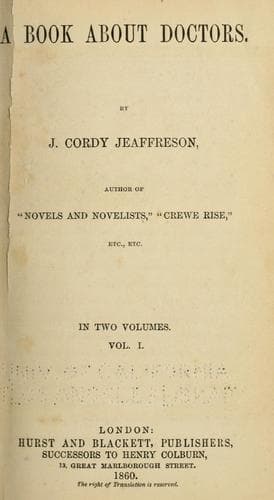
Medicine -- Anecdotes; Physicians -- Great Britain
Possibly in ancient times the physician's cane and the surgeon's club
were used more actively. For many centuries fustigation was believed
in as a sovereign remedy for bodily ailment as well as moral failings,
and a beating was prescribed for an ague as frequently as for picking
and stealing. This process Antonius Musa employed to cure Octavius
Augustus of Sciatica. Thomas Campanella believed that it had the same
effect as colocynth administered internally. Galen recommended it as a
means of fattening people. Gordonius prescribed it in certain cases of
nervous irritability--"Si sit juvenis, et non vult obedire,
flagelletur frequenter et fortiter." In some rural districts ignorant
mothers still flog the feet of their children to cure them of
chilblains. And there remains on record a case in which club-tincture
produced excellent results on a young patient to whom Desault gave a
liberal dose of it.
In 1792, when Sir Astley Cooper was in Paris, he attended the lectures
of Desault and Chopart in the Hotel Dieu. On one occasion, during this
part of his student course, Cooper saw a young fellow, of some sixteen
years of age, brought before Desault complaining of paralysis in his
right arm. Suspecting that the boy was only shamming, "Abraham,"
Desault observed, unconcernedly, "Otez votre chapeau."
Forgetting his paralytic story, the boy instantly obeyed, and
uncovered his head.
"Donnez moi un baton!" screamed Desault; and he beat the boy
unmercifully.
"D'ou venez vous?" inquired the operator when the castigation was
brought to a close.
"Faubourg de St. Antoine," was the answer.
"Oui, je le crois," replied Desault, with a shrug--speaking a truth
experience had taught him--"tous les coquins viennent de ce quartier
la."
But enough for the present of the barber-surgeon and his pole.
"Tollite barberum,"--as Bonnel Thornton suggested, when in 1745 (a
year barbarous in more ways than one), the surgeons, on being
disjoined from the barbers, were asking what ought to be their motto.
Next to his cane, the physician's wig was the most important of his
accoutrements. It gave profound learning and wise thought to lads just
out of their teens. As the horse-hair skull-cap gives idle Mr.
Briefless all the acuteness and gravity of aspect which one looks for
in an attorney-general, so the doctor's artificial locks were to him a
crown of honour. One of the Dukes of Holstein, in the eighteenth
century, just missed destruction through being warned not to put on
his head a poisoned wig which a traitorous peruke-maker offered him.
To test the value of the advice given him, the Duke had the wig put
upon the head of its fabricator. Within twelve minutes the man
expired! We have never heard of a physician finding death in a wig;
but a doctor who found the means of life in one is no rare bird in
history.
Public-domain text, read in full here on John Shaqi.
Reviews
Reviews
No reviews yet
Be the first to share your thoughts on this work.
Join the Discussion
Join the discussion
Sign in to leave a comment or review.
Sign InorCreate an account