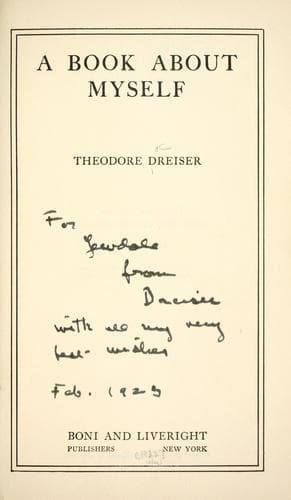
Dreiser, Theodore, 1871-1945; Journalists -- United States -- Biography; Novelists, American -- 20th century -- Biography
political or social organization or an individual but in the course of
time was guilty of an infraction of some kind of this seemingly perfect
and unbroken social and moral code. But in spite of all this, judging by
the editorial page, the pulpit and the noble mouthings of the average
citizen speaking for the benefit of his friends and neighbors, all men
were honest—only they weren’t; all women were virtuous and without evil
intent or design—but they weren’t; all mothers were gentle,
self-sacrificing slaves, sweet pictures for songs and Sunday
Schools—only they weren’t; all fathers were kind, affectionate, saving,
industrious—only they weren’t. But when describing actual facts for the
news columns, you were not allowed to indicate these things. Side by
side with the most amazing columns of crimes of every kind and
description would be other amazing columns of sweet mush about love,
undying and sacrificial, editorials about the perfection of the American
man, woman, child, his or her sweet deeds, intentions and the like—a
wonderful dose. And all this last in the face of the other, which was
supposed to represent the false state of things, merely passing
indecencies, accidental errors that did not count. If a man like Hazard
or myself had ventured to transpose a true picture of facts from the
news columns of the papers, from our own reportorial experiences, into a
story or novel, what a howl! Ostracism would have followed much more
swiftly in that day than in this, for today turgid slush approximating
at least some of the facts is tolerated. Fifteen years later Hazard told
me he still had his book buried in a trunk somewhere, but by then he had
turned to adventurous fiction, and a year later, as I have said, be blew
his brains out.
Just the same the book made a great impression on me! It gave me a great
respect for Hazard, made me really fond of him. And it fixed my mind
definitely on this matter of writing—not a novel, curiously, but a play,
a form which from the first seemed easier for me and which I still
consider so, one in which I work with greater ease than I do in the
novel. I mentioned to Wood and McCord that Hazard and another man had
written a novel and that I had read it. I must have enthused over it for
both were impressed, and I myself seemed to gain standing, especially
with Wood. It was generally admitted then that Hazard was one of the
best reporters in the city, and my being taken into his confidence in
this fashion seemed to Wood to be a significant thing.
Public-domain text, read in full here on John Shaqi.
Reviews
Reviews
No reviews yet
Be the first to share your thoughts on this work.
Elsewhere in the archive
Join the Discussion
Join the discussion
Sign in to leave a comment or review.
Sign InorCreate an account