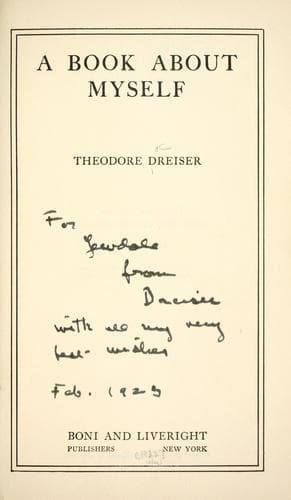
Dreiser, Theodore, 1871-1945; Journalists -- United States -- Biography; Novelists, American -- 20th century -- Biography
To this day some of the scenes of this book come back to me as having
been forcefully done—the fight between the two actresses, for one thing,
a midnight feast with several managers, the gallows scene, a confession.
I am not sure of the name of the newspaper man who collaborated with
Hazard on this work, but the picture of his death in an opium joint
later, painted for me by Hazard, and the eccentricities of his daily
life, stand out even now as Poe-like. He must have been blessed or
cursed with some such temperament as that of Poe, dark, gloomy,
reckless, poetic, for he was a dope-fiend and died of dope.
Be that as it may, this posthumous work, never published, so far as I
know, was the opening wedge for me into the realm of realism. Being
distinctly imitative of Balzac and Zola, the method was new and to me
impressive. It has always struck me as curious that the first novel
written by an American that I read in manuscript should have been one
which by reason of its subject matter and the puritanic character of the
American mind could never be published. These two youths knew this.
Hazard handed it to me with the statement: “Of course a thing like this
could never be published over here. We’d have to get it done abroad.”
That struck me as odd at the time—the fact that if one wrote a fine
thing nevertheless because of an American standard I had not even
thought of before, one might not get it published. How queer, I thought.
Yet these two incipient artists had already encountered it. They had
been overawed to the extent of thinking it necessary to write of French,
not American life in terms of fact. Such things as they felt called upon
to relate occurred only in France, never here—or at least such things,
if done here, were never spoken of. I think it nothing less than tragic
that these men, or boys, fresh, forceful, imbued with a burning desire
to present life as they saw it, were thus completely overawed by the
moral hypocrisy of the American mind and did not even dare to think of
sending their novel to an American publisher. Hazard was deeply
impressed with the futility of attempting to do anything with a book of
that kind. The publishers wouldn’t stand for it. You couldn’t write
about life as it was; you had to write about it as somebody else thought
it was, the ministers and farmers and dullards of the home. Yet here he
was, as was I, busy in a profession that was hourly revealing the fact
that this sweetness and light code, this idea of a perfect world which
contained neither sin nor shame for any save vile outcasts, criminals
and vagrants, was the trashiest lie that was ever foisted upon an all
too human world. Not a day, not an hour, but the pages of the very
newspaper we were helping to fill with our scribbled observations were
full of the most incisive pictures of the lack of virtue, honesty,
kindness, even average human intelligence, not on the part of a few but
of nearly everybody. Not a business, apparently, not a home, not a
Public-domain text, read in full here on John Shaqi.
Reviews
Reviews
No reviews yet
Be the first to share your thoughts on this work.
Elsewhere in the archive
Join the Discussion
Join the discussion
Sign in to leave a comment or review.
Sign InorCreate an account