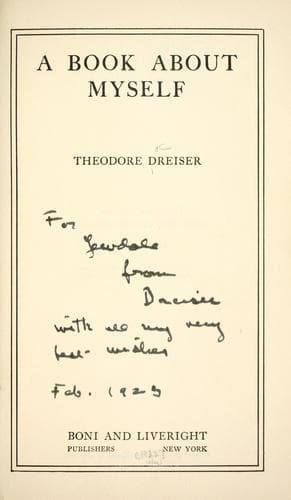
Dreiser, Theodore, 1871-1945; Journalists -- United States -- Biography; Novelists, American -- 20th century -- Biography
I would not make so much of this great honor if it were not for what it
meant to me then. The room was large and dark, on Broadway between
Market and Walnut, with the cars jangling below. It contained one great
white bed, a long table covered with the papers and literary
compositions of Mr. Richard Wood, and was decorated and reinforced with
that gentleman’s conception of what constituted literary insignia. On
the walls hung dusty engravings representing the death of Hamlet and the
tempting of Faust. In one corner, over a chest of drawers, was the
jagged blade of a sword-fish, and in another a most curious display of
oriental coins. The top of the wardrobe was surmounted by a gruesome
_papier-mâché_ head representing that somewhat demented creature known
in England as Ally Sloper. A clear space at one corner of the table held
a tin pail for carrying beer, and the floor, like the walls, was covered
with some dusty brown material which might once have been a carpet.
Owing to the darkness of the furnishings and the brightness of the fire,
the room had a very cheery look.
“Say, Dick, did you see where one of ——’s plays had made a great hit in
New York?” asked McCord. “He’s made a strike this time.”
“No,” replied Dick solemnly, poking among the coals of the grate and
drawing up a chair. “Sit down, Dreiser. Pull up a chair, Peter. This
confounded grate smokes whenever the wind’s from the South. Still
there’s nothing like a grate fire.”
We drew up chairs. I was revolving in my mind the charm of the room and
a vision of greatness in play-writing. These two men seemed subtly
involved with the perfection of the arts. In this atmosphere, with such
companions, I felt that I could accomplish anything, and soon.
“I’ll tell you how it is with the game of play-writing,” observed Dick
sententiously. “You have to have imagination and feeling and all that,
but what’s more important than anything is a little business sense, to
know how to get in with those fellows. You might have the finest play in
the world in your pocket, but if you didn’t know how to dispose of it
what good would it do you? None at all. You got to know that end first.”
He reached over and pulled the coal-scuttle into position as a footrest
and then looked introspectively at the ceiling.
“The play’s the thing,” put in Peter. “If you could write a real good
play you wouldn’t need to worry about getting it staged.”
“Aw, wouldn’t I? Listen to that now!” commented Dick irascibly. “I tell
you, Peter, you don’t know anything about it. You only think you do;
that’s all. Say, did Campbell have a good play in his pocket or didn’t
he? You betcher neck he did. Did he get it staged? No, you betcher boots
he didn’t. Don’t talk to me; I know.”
By his manner you would have thought he had a standing bone to pick with
Peter, but this was only his way. It made me laugh.
“Well, the play’s the first thing to worry about anyhow,” I observed. “I
wish I were in a position to write one.”
Public-domain text, read in full here on John Shaqi.
Reviews
Reviews
No reviews yet
Be the first to share your thoughts on this work.
Elsewhere in the archive
Join the Discussion
Join the discussion
Sign in to leave a comment or review.
Sign InorCreate an account