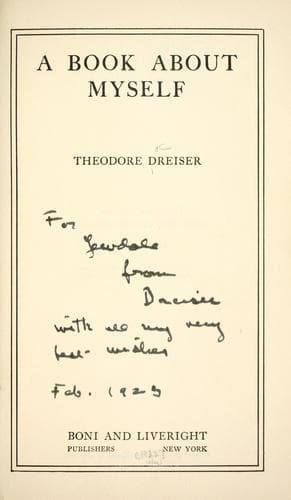
Dreiser, Theodore, 1871-1945; Journalists -- United States -- Biography; Novelists, American -- 20th century -- Biography
Dick picked up a single manuscript from a heap. “I don’t want to inflict
this on you, Dreiser,” he said sweetly and apologetically. “We had
planned to do this before I knew you were coming.”
“That’s the way he always talks,” put in Peter banteringly. “Dick loves
to stage things. But they’re great stories just the same.”
I leaned back, prepared to be thrilled. Dick drew up his chair to the
table and adjusted a green-shaded gas lamp close to the table’s edge. He
then unfolded his MS. and began reading in a low, well-modulated,
semi-pathetic voice, which seemed very effective in the more sentimental
passages. Reverently I sat and listened. The tale was nothing, a mere
daub, but, oh, the wonder of it! Was I not in the presence and
friendship of artists? Was not this Bohemia? Had I not long heard and
dreamed of it? Well, then, what difference whether the tales were good
or bad? They were by one whom I was compelled to admire, an artist,
pale, sensitive, recessive, one who at the slightest show of inattention
or lack of appreciation might leave me and never see me more.
I listened to about nine without dying, declaring each and every one to
be the best I had ever heard—perfect.
------------------------------------------------------------------------
CHAPTER XXIV
FROM now on, because of this companionship, my life in St. Louis took on
a much more cheerful aspect. Hitherto, in spite of my work and my
natural interest in a strange city, I had had intensely gloomy moments.
My favorite pastime, when I was not out on an assignment or otherwise
busy, was to walk the streets and view the lives and activities of
others, not thinking so much how I might advantage myself and my affairs
as how, for some, the lightning of chance was always striking in
somewhere and disrupting plans, leaving destruction and death in its
wake, for others luck or fortune. I never was blinded to the gross
favoritism practiced by nature, and this I resented largely, it may be,
because it was not, or I thought it was not, practiced in my behalf.
Later in life I began to suspect that a gross favoritism, in regard to
certain things at least, was being practiced in my behalf. I was never
without friends, never without some one to do me a good turn at a
critical moment, never without love and the sacrifice of beauty on the
part of some one in my behalf, never without a certain amount of
applause or repute. Was I worthy of it? I knew I was not and I felt that
the powers that make and control life did not care two whoops whether I
was or not.
Public-domain text, read in full here on John Shaqi.
Reviews
Reviews
No reviews yet
Be the first to share your thoughts on this work.
Elsewhere in the archive
Join the Discussion
Join the discussion
Sign in to leave a comment or review.
Sign InorCreate an account