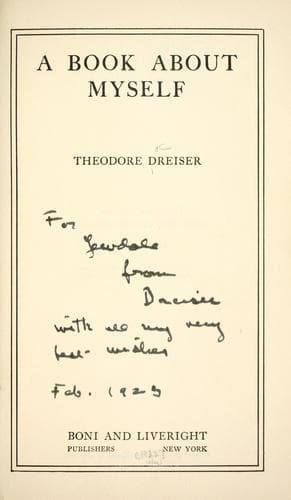
Dreiser, Theodore, 1871-1945; Journalists -- United States -- Biography; Novelists, American -- 20th century -- Biography
As I was writing, my head whirring with the imaginary and impossible
splendors of the occasion, I was informed by my city editor that when I
was done I should go to a number in South St. Louis where only an hour
before a triple or quadruple murder had been committed. I was to go out
on a street-car and if I could not get back in time by street-car I was
to get a carriage and drive back at breakneck speed in order to get the
story into the last edition. The great fear was that the rival paper,
the _Republic_, would get it or might already have it and we would not.
And so, my head full of pearls, diamonds, silks, satins, laces, a world
of flowers and lights, I was now hustled out along the dark, shabby,
lonely streets of South St. Louis to the humblest of cottages, in the
humblest of streets where, among unpainted shacks with lean-tos at the
back for kitchens, was one which contained this story.
An Irish policeman, silent and indifferent, was already at the small
dark gate in the dark and silent street, guarding it against intruders;
another was inside the door, which stood partially open, and beyond in
the roadway in the darkness, their faces all but indistinguishable, a
few horrified people. A word of explanation and I was admitted. A faint
glow from a small smoky glass lamp illuminated the front room darkly. It
turned out that a very honest, simple, religious and good-natured
Irish-American of about fifty, who had been working by the day in this
neighborhood, had recently been taken ill with brain fever and had on
this night arisen from his feverish sickbed, seized a flatiron, crept
into the front room where his wife and two little children slept and
brained all three. He had then returned to the rear room, where a grown
daughter slept on a couch beside him, and had first felled her with the
iron and then cut her throat with a butcher knife. Murderous as the deed
seemed, and apparently premeditated, it was the result of fever. The
policeman at the gate informed me that the father had already been taken
to the Four Courts and that a hospital ambulance was due any moment.
“But he’s out av his mind,” he insisted blandly. “He’s crazy, sure, or
sick av the fever. No man in his right sinses would do that. I tried to
taalk to him but he couldn’t say naathin’, just mumble like.”
After my grand ball this wretched front room presented a sad and ghastly
contrast. The house and furniture were very poor, the dead wife and
children homely and seemingly work-worn. I noticed the dim, smoky flame
cast by the lamp, the cheap bed awry and stained red, the mother and two
children lying in limp and painful disorder, the bedding dragged half
off. It was evident that a struggle had taken place, for a chair and
table were upset, the ironing-board thrown down, a bureau and the bed
pushed sidewise.
Public-domain text, read in full here on John Shaqi.
Reviews
Reviews
No reviews yet
Be the first to share your thoughts on this work.
Elsewhere in the archive
Join the Discussion
Join the discussion
Sign in to leave a comment or review.
Sign InorCreate an account