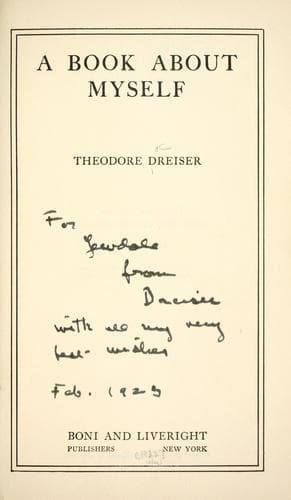
Dreiser, Theodore, 1871-1945; Journalists -- United States -- Biography; Novelists, American -- 20th century -- Biography
Shocked beyond measure, yet with an eye to color and to the zest of the
public for picturesque details, I examined the three rooms with care,
the officer in the house following me. Together we looked at the
utensils in the kitchen, what was in the cupboard to eat, what in the
closet to wear. I made notes of the contents of the rooms, their
cheapness, then went to the neighbors on either hand to learn if they
had heard anything. Then in a stray owl-car, no carriages being
available, I hurried to the Four Courts, several miles cityward, to see
the criminal. I found him, old, pale, sick, thin, walking up and down in
his small iron cell, plainly out of his mind, a picture of hopeless,
unconscious misery. His hands trembled idly about his mouth; his shabby
trousers bagged about his shoes; he was unshaven and weak-looking, and
all the while he mumbled to himself some unintelligible sounds. I tried
to talk with him but could get nothing. He seemed not even to know that
I was there, so brain-sick was he. Then I questioned the jail
attendants, those dull wiseacres of the law. Had he talked? Did they
think he was sane? With the usual acumen and delicacy of this tribe,
they were inclined to think he was shamming.
I hurried through dark streets to the office. It was an almost empty
reportorial room in which I scribbled my dolorous picture. With the
impetuosity of youth and curiosity and sorrow and wonder I told it all,
the terror, the pity, the inexplicability. As I wrote, each page was
taken up by Hartung, edited and sent up. Then, having done perhaps a
column and a half (Bellairs having arrived with various police
theories), I was allowed finally to amble out into a dark street and
seek my miserable little room with its creaky bed, its dirty coverlets,
its ragged carpets and stained walls. Nevertheless, I lay down with a
kind of high pride and satisfaction in my story of the murder and my
description of the ball, and with my life in consequence! I was not so
bad. I was getting along. I must be thought an exceptional man to be
picked for two such difficult tasks in the same evening. Life itself was
not so bad; it was just higgledy-piggledy, catch-as-catch-can, that was
all. If one were clever, like myself, it was all right. Next morning,
when I reached the office, McCord and Hazard and some others pronounced
my stuff “pretty good,” and I was beside myself with glee. I strolled
about as though I owned the earth, pretending simplicity and humility
but actually believing that I was the finest ever, that no one could
outdo me at this game of reporting.
------------------------------------------------------------------------
CHAPTER XXV
Public-domain text, read in full here on John Shaqi.
Reviews
Reviews
No reviews yet
Be the first to share your thoughts on this work.
Elsewhere in the archive
Join the Discussion
Join the discussion
Sign in to leave a comment or review.
Sign InorCreate an account