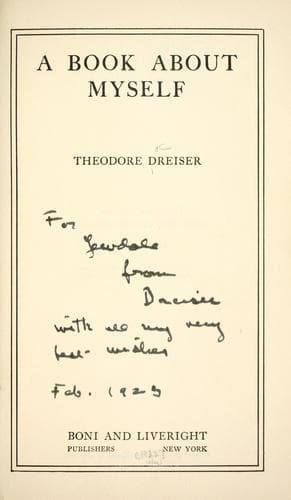
Dreiser, Theodore, 1871-1945; Journalists -- United States -- Biography; Novelists, American -- 20th century -- Biography
And there were distinguished individuals, including such excellent
lecturers as Henry Watterson and Henry M. Stanley, or a musician like
Paderewski, or a scientist of the standing of Nikola Tesla. I was sent
to interview my share of these, to get their views on something—anything
or nothing really, for my city editor, Mr. Mitchell, seemed at times a
little cloudy as to their significance, and certainly I had no clear
insight into What most of them stood for. I wondered, guessed, made
vague stabs at what I thought they represented, and in the main took
them seriously enough. My favorite question was What did they think of
life, its meaning, since this was uppermost in my mind at the time, and
I think I asked it of every one of them, from John L. Sullivan to Annie
Besant. And what a jangle of doctrines! What a noble burst of ideas!
Annie Besant, in a room at the Southern delicately scented with flowers,
arrayed in a cool silken gray dress, informed me that the age was
material, that wealth and show were an illusion based on nothing at all
(I wrote that down without understanding what she meant), that the Hindu
Swamis had long since solved all this seeming mystery of living, Madame
Blavatsky being the most recent and the greatest apostle of wisdom in
this matter, and that the great thing to do in this world or the next
was to improve oneself spiritually and so eventually attain to Nirvana,
nothingness—a word I had to look up afterward. (When I told Dick Wood
about her he seemed greatly impressed and said: “Oh, there’s more to
that stuff than you think, Dreiser. You’re just not up on all that yet.
These mystics see more than we think they do,” and he looked very wise.)
And Henry Watterson—imagine me at the age of twenty-one trying to
interview him when he was in the heyday of his fame and mental powers!
Short, stocky, with a protuberant belly, slightly gray hair, gruff and
simple in his manner and joyously secure in his fame (he had just the
preceding summer said that Cleveland, Democratic candidate of the hour
and later elected, was certain to “walk up an alley to a slaughter-house
and an open grave,” and had of course seen his prediction fail), he was
convinced that the country was in bad hands, not likely to go to the
“demnition bow-wows” as yet but in for a bad corporation-materialistic
spell. And when I asked _him_ what he thought of life——
“My son, when you get as old as I am you probably won’t think so much of
it, and you won’t be to blame. It’s good enough in its way, but it’s a
damned ticklish business. You may say that Henry Watterson said that if
you like. Do the best you can, and don’t crowd the other fellow too
hard, and you’ll come out as well as anybody, I suppose.”
Public-domain text, read in full here on John Shaqi.
Reviews
Reviews
No reviews yet
Be the first to share your thoughts on this work.
Elsewhere in the archive
Join the Discussion
Join the discussion
Sign in to leave a comment or review.
Sign InorCreate an account