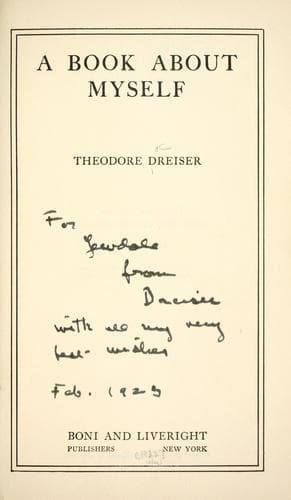
Dreiser, Theodore, 1871-1945; Journalists -- United States -- Biography; Novelists, American -- 20th century -- Biography
often trailing the reporters, reading the newspapers to discover what
had been discovered, and then, when the work had been done and the true
clew furnished, would step forward at the grand moment to do the
arresting and get their pictures and names in the papers. The detectives
were constantly playing into the hands of the police reporters in
unimportant matters during periods between great cases, doing them
little favors, helping them in small cases, in order that when a big
case came along they might have favors done unto them. The most
important of all these favors, of course, was that of seeing that their
names were mentioned in the papers as being engaged in solving a mystery
or having done thus and so, when in all likelihood some newspaper man
had done it.
Sometimes the tip as to where the criminal was likely to be found would
be furnished by the papers and later credited to the police. Sometimes
the newspaper men would lash the police, sometimes flatter them, but
always they were seeking to make the police aid them to get various
necessary things done, and not always succeeding. Sometimes the police
were hand-in-glove with certain crooks or evil-doers, and you could all
but prove it, but until you did so, and sometimes afterward, they were
stubborn and would defy you and the papers. But not for long. They loved
publicity too much; offer them sufficient publicity, and they would act.
It was nearly always my experience that the newspapers, which meant the
reporters of course plus an efficient city editor and possibly a
managing editor, would be the first to worm out the psychology of any
given case and then point an almost unerring finger at the criminal;
then the police or detectives would come in and do the arresting and get
the credit.
Another thing that impressed me greatly at this time was the
kaleidoscopic character of newspaper work, which, in its personal
significance to me, cannot be too much emphasized. As I have said, one
day it would be a crime of a lurid or sensational character that would
arrest and compel me to think, and the same day, within the hour
perhaps, it would be a lecturer or religionist with some finespun theory
of life, some theosophist like Annie Besant, who in passing through St.
Louis on a lecture tour would be at one of the best hotels, usually the
Southern, talking transmigration and Nirvana. Again, it would be some
mountebank or quack of a low order—a spiritualist, let us say, of the
Eva Fay stripe, or a mindreader like Bishop, or a third-rate religionist
like the Reverend Sam Jones, who was then in his heyday preaching
unadulterated hell, or the arrival of a prize-fighter-actor like John L.
Sullivan, then only recently defeated by Corbett, or a novelist of the
quack order, such as Hall Caine.
Public-domain text, read in full here on John Shaqi.
Reviews
Reviews
No reviews yet
Be the first to share your thoughts on this work.
Elsewhere in the archive
Join the Discussion
Join the discussion
Sign in to leave a comment or review.
Sign InorCreate an account