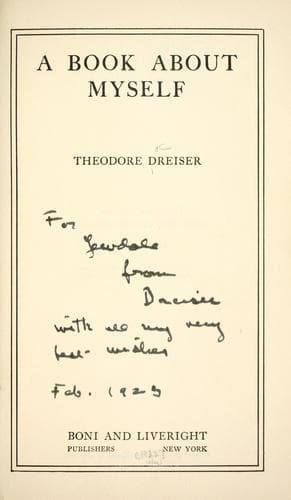
Dreiser, Theodore, 1871-1945; Journalists -- United States -- Biography; Novelists, American -- 20th century -- Biography
Another thing that interested me about newspaper work was its pagan or
unmoral character, as contrasted with the heavy religionistic and
moralistic point of view seemingly prevailing in the editorial office
proper (the editorial page, of course), as well as the world outside.
While the editorial office might be preparing the most flowery
moralistic or religionistic editorials regarding the worth of man, the
value of progress, character, religion, morality, the sanctity of the
home, charity and the like, the business office and news rooms were
concerned with no such fine theories. The business office was all
business, with little or no thought of anything save success, and in the
city news room the mask was off and life was handled in a
rough-and-ready manner, without gloves and in a catch-as-catch-can
fashion. Pretense did not go here. Innate honesty on the part of any one
was not probable. Charity was a business with something in it for
somebody. Morality was in the main for public consumption only. “Get the
news! Get the news!”—that was the great cry in the city editorial room.
“Don’t worry much over how you get it, but get it, and don’t come back
without it! Don’t fall down! Don’t let the other newspapers skin us—that
is, if you value your job! And write—and write well. If any other paper
writes it better than you do you’re beaten and might as well resign.”
The public must be entertained by the writing of reporters.
But the methods and the effrontery and the callousness necessary at
times for the gathering of news—what a shock even though one realized
that it was conditional with life itself! At most times one needed to be
hard, cold, jesuitical. For instance, one of the problems that troubled
me most, and to which there was no solution save to act jesuitically or
get out, was how to get the facts from a man or woman suspected of some
misdeed or error without letting him know that you were so doing. In the
main, if you wanted facts of any kind, especially in connection with the
suspected, you did not dare tell them that you came as an enemy or were
bent on exposing them. One had to approach all, even the worst and most
degraded, as a friend and pretend an interest, perhaps even a sympathy
one did not feel, to apply the oil of flattery to the soul. To do less
than this was to lose the news, and while a city editor might readily
forgive any form of trickery he would never forgive failure. Cheat and
win and you were all right; be honest and lose and you were fired. To
appear wise when you were ignorant, dull when you were not,
disinterested when you were interested, brutal or severe when you might
be just the reverse—these were the essential tricks of the trade.
Public-domain text, read in full here on John Shaqi.
Reviews
Reviews
No reviews yet
Be the first to share your thoughts on this work.
Elsewhere in the archive
Join the Discussion
Join the discussion
Sign in to leave a comment or review.
Sign InorCreate an account