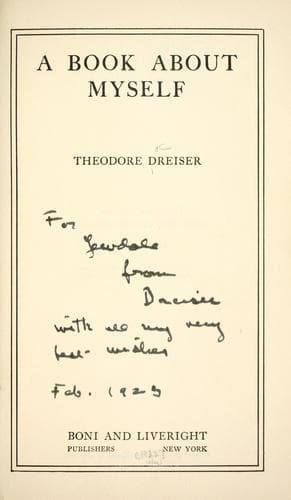
Dreiser, Theodore, 1871-1945; Journalists -- United States -- Biography; Novelists, American -- 20th century -- Biography
And I, being sent out every day and loafing about the corridors of the
various hotels at different times, soon encountered other newspaper men
who were as shrewd and wily as ferrets, who had apparently but one
motive in life: to trim their fellow newspaper men in the matter of
news, or the public which provided the news. There being only two
morning papers here (the _Globe_ and the _Republic_), the reporters of
each loved the others not, even when personally they were inclined to be
friendly. They did not dare permit their personal likes to affect their
work. It was every man for himself. Meet a reporter of the _Republic_ or
the _Globe_ on a story: he might be friendly enough but he would tell
you nothing. He wished either to shun you or worm your facts out of you.
Meet him in the lobby of the La Clede, where by common consent, winter
or summer, most seemed to gather, or at the corner drugstore outside,
and each would be friendly with the other, trading tales of life, going
together to a saloon for a drink or to the “beanery,” a famous
eating-place on Chestnut between Fourth and Broadway, perhaps borrowing
a dime, a quarter or a dollar until pay day—but never repaying with news
or tips; quite the reverse, as I soon found. One had to keep an
absolutely close mouth as to all one might be doing.
The counsel of all of these men was to get the news in any way possible,
by hook or by crook, and to lose no time in theorizing about it. If a
document was lying on an official’s table, for instance, and you wanted
to see it and could not persuade him to give it to you—well, if he
turned his back it was good business to take it, or at least read it. If
a photograph was desired and the one concerned would not give it and you
saw it somewhere, take it of course and let them complain afterward if
they would; your city editor was supposed to protect you in such
matters. You might know of certain conditions of which a public official
was not aware and the knowledge of which would cause him to talk in one
way, whereas lack of that knowledge would cause him to talk in another.
Personally you might think it your duty to tell him, but as a newspaper
man you could not. It was your duty to your paper to sacrifice him. If
you didn’t some one else would. I was not long in learning all this and
more, and although I understood the necessity I sometimes resented
having to do it. There were times when I wanted to treat people better
than I did or could. Sometimes I told myself that I was better in this
respect than other newspaper men; but when the test came I found that I
was like the others, as eager to get the news. Something akin to a dog’s
lust of the chase would in critical moments seize upon me and in my
eagerness to win a newspaper battle I would forget or ignore nearly
every tenet of fairness and get it. Then, victorious, I might sigh over
the sadness of it all and decide that I was going to get out of the
Public-domain text, read in full here on John Shaqi.
Reviews
Reviews
No reviews yet
Be the first to share your thoughts on this work.
Elsewhere in the archive
Join the Discussion
Join the discussion
Sign in to leave a comment or review.
Sign InorCreate an account