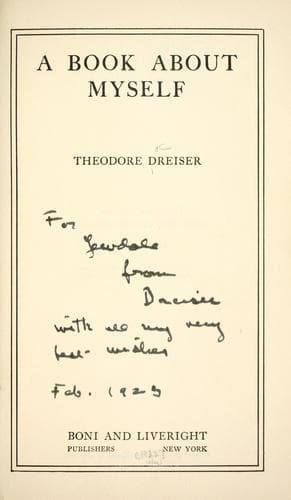
Dreiser, Theodore, 1871-1945; Journalists -- United States -- Biography; Novelists, American -- 20th century -- Biography
If I had been of an ordinary, sensible, everyday turn of mind, with a
modicum of that practical wisdom which puts moderate place and position
first and sets great store by the saving of money, I might have
succeeded fairly well here, much better than I did anywhere else for a
long period after. Unquestionably Mr. McCullagh liked me; I think he may
have been fond of me in some amused saturnine way, interested to keep
such a bounding, high-flown dunce about the place. I might have held
this place for a year or two and made it a stepping-stone to something
better. But instead of rejoicing in the work and making it the end and
aim of my daily labors, I looked upon it as a mere bauble, something I
had today but might not have tomorrow. And anyhow, there were better
things than working day by day and living in a small room. Life ought
certainly to bring me something better, something truly splendid—and
soon. I deserved it—everything, a great home, fine clothes, pretty
women, the respect and companionship of famous men. Indeed all my pain
and misery was plainly caused by just such a lack or lacks as this. Had
I these things all would be well; without them—well, I was very
miserable. I was ready to accept socialism if by that I could get what I
wanted, while not ready to admit that all people were as deserving as I
by any means. The sad state of the poor workingman was a constant
thought with me, but nearly always I was the greatest and poorest and
most deserving of all workingmen.
This view naturally tended to modify the sanity of my work. Granting a
modicum of imagination and force, still any youth limited as I was at
that time has a long road to go. Even in that most imaginative of all
professions, the literary, the possessor of such notions as I then held
is certainly debarred from accomplishing anything important until he
passes beyond them. Yet the particular thought or attitude I have
described appears to reign in youth. Too often it is a condition of many
minds of the better sort and is retained in its worst form until by
rough experience it is knocked out of them or they are destroyed utterly
in the process. But it cannot be got over with quickly. Mine was a sad
case. One of the things which this point of view did for me was to give
my writing, at that time, a mushy and melancholy turn which would not go
in any newspaper of today, I hope. It caused me to paint the ideal as
not only entirely probable but necessary before life would be what it
should!—the progress bug, as you see. I could so twist and discolor the
most commonplace scenes as to make one think that I was writing of
paradise. Indeed I allowed my imagination to run away with me at times
and only the good sense of the copy-reader or the indifference of a
practical-minded public saved the paper from appearing utterly
ridiculous.
Public-domain text, read in full here on John Shaqi.
Reviews
Reviews
No reviews yet
Be the first to share your thoughts on this work.
Elsewhere in the archive
Join the Discussion
Join the discussion
Sign in to leave a comment or review.
Sign InorCreate an account