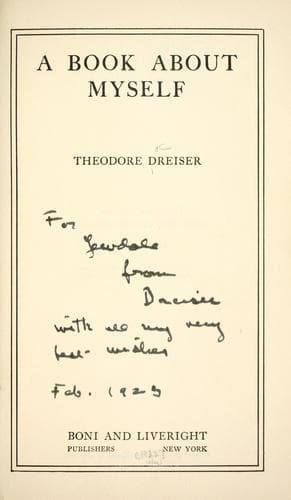
Dreiser, Theodore, 1871-1945; Journalists -- United States -- Biography; Novelists, American -- 20th century -- Biography
On one occasion, for instance, I went to report a play of mediocre
quality that was running at the Olympic, and was so impressed with a
love scene which was a part of it that I was entirely blinded to all the
faults of construction which the remainder of the play showed, and wrote
it up in the most glowing colors. And the copy-reader, Hartung, was too
weary that night or too inattentive to capture it. The next day some of
the other newspaper men in the office noticed it and commented on it to
me or to Hartung, saying it was ridiculously high-flown and that the
play itself was silly, which was true. But did that cure me? Not a bit.
I was reduced for a day or two by it, but not for long. Seeing other
plays of the same caliber and with much sweet love mush in them, I raved
as before.
A little later a negro singer, a young woman of considerable vocal
ability who was being starred as the Black Patti, was billed to appear
in St. Louis. The manager of the bureau that was presenting her called
my attention by letter to her “marvelous” ability, and by means of
clippings and notices of her work published elsewhere had endeavored to
impress me favorably. I read these notices, couched in the glowing
phrases of the press-agent, and then went forth on this evening to cover
this myself. To make it all the grander, I invited McCord and with him
proceeded to the theater, where we were assigned a box.
As it turned out, or as I chanced to see or feel it, the young woman was
a sweet and impressive singer, engaging and magnetic. McCord agreed with
me that she could sing. We listened to the program of a dozen pieces,
including such old favorites as _Suwanee River_ and _Comin’ Thro’ the
Rye_, and then I, being greatly moved, returned to the office and wrote
an account that was fairly sizzling with the beauty which I thought was
there. I did not attempt critically to analyze her art—I could not,
knowing nothing of even the rudiments of music—but plunged at once into
that wider realm which involved the subtleties of nature itself. “What
is so beautiful as the sound which the human voice is capable of
producing,” I wrote in part, “especially when that voice is itself a
compound of the subtlest things in nature? Here we have a young girl,
black it is true, fresh from the woods and fields of her native country,
yet, blessed by some strange chance with that mystic thing, a voice, and
fittingly interpreting via song all that we hold to be most lovely. The
purling of the waters, the radiance of the moonlight, the odor of sweet
flowers, sunlight, storm, the voices and echoes of nature, all are found
here, thrilling over lips which represent in their youthfulness but a
few of the years which wisdom and skill would seem to require. Yes, one
may sit and, in hearing Miss Jones sing, vicariously entertain all these
things, because of them she is a compound, youthful, vivacious,
suggestive of the elemental sweetness of nature itself.”
Public-domain text, read in full here on John Shaqi.
Reviews
Reviews
No reviews yet
Be the first to share your thoughts on this work.
Elsewhere in the archive
Join the Discussion
Join the discussion
Sign in to leave a comment or review.
Sign InorCreate an account