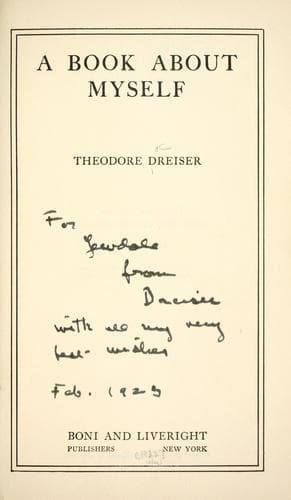
Dreiser, Theodore, 1871-1945; Journalists -- United States -- Biography; Novelists, American -- 20th century -- Biography
“Tomorrow is my wedding-day. Tomorrow at twelve. This may strike
you as strange. Well, I have waited—I don’t know how long—it has
seemed like years to me—for some word, but I knew it was not to
be. Your last letter showed me that. I knew that you did not
intend to return, and so I went back to Mr. ——. I had to. What
else have I to look forward to? You know how unhappy I am here
with my family, now that you are gone, in spite of how much they
care for me.
“Oh, Theo, you must think me foolish for writing this. I am
ashamed of myself. Still, I wanted to let you know, and to say
good-bye, for although you have been indifferent I cannot bear
any hard feelings toward you. I will make Mr. —— a good wife. He
understands I do not love him, but that I appreciate him.
Tomorrow I will marry him, unless—unless something happens. You
ought not to have told me that you loved me, Theo, unless you
could have stayed with me. You have caused me so much pain.
“But I must say good-bye. This is the last letter I shall ever
write you. Don’t send my letters now—tear them up. It is too
late. Oh, if you only knew how hard it has been to bring myself
to this!
“ALICE.”
I sat and stared at the floor after reading this. The pain I had caused
was a heavy weight. The implication that if I would come to Chicago
before noon of this day, or telegraph for her to delay, was too much.
What if I should go to Chicago and get her—then what? To her it would be
a beautiful thing, the height of romance, saving her from a cruel or
dreary fate; but what of me? Should I be happy? Was my profession or my
present restless and uncertain state of mind anything to base a marriage
on? I knew it was not.... I also knew that Alice, in spite of my great
sadness and affection for her, was really nothing more to me than a
passing bit of beauty, charming in itself but of no great import to me.
I was sad for her and for myself, saddest because of that chief
characteristic of mine and of life which will not let anything endure
permanently: love, wealth, fame. I was too restless, too changeful.
There rose before me a picture of my finances as compared with what they
ought to be, and of any future in marriage based on it. Actually, as I
looked at it then, it was more the fault of life than mine.
These thoughts, balancing with the wish I had for greater advancement,
caused me as usual to hesitate. But I was in no danger of doing anything
impulsive: there was no great impelling passion in this. It was mere
sentiment, growing more and more roseate and less and less operative. I
groaned inwardly, but night came and the next day, and I had not
answered. At noon Alice had been married, as she afterward told me—years
afterward, when the fire was all gone and this romance was ended
forever.
------------------------------------------------------------------------
Public-domain text, read in full here on John Shaqi.
Reviews
Reviews
No reviews yet
Be the first to share your thoughts on this work.
Elsewhere in the archive
Join the Discussion
Join the discussion
Sign in to leave a comment or review.
Sign InorCreate an account