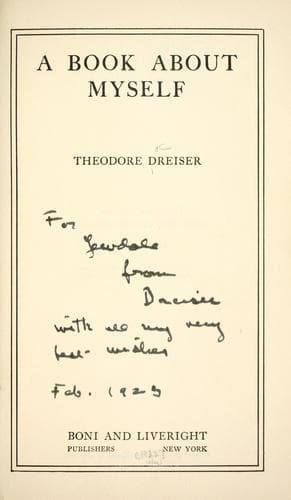
Dreiser, Theodore, 1871-1945; Journalists -- United States -- Biography; Novelists, American -- 20th century -- Biography
When I reached the scene of the supposed hold-up there was nothing to
guide me. The people at the car-barns did not know anything about it and
the crew that had been held up was not present. I visited a far outlying
police station but the sergeant in charge could tell me nothing more
than that the crime was not very important, a few dollars stolen. I went
to the exact spot but there were no houses in the neighborhood, only a
barren stretch of track lying out in a rain-soaked plain. It was a
gloomy, wet night, and I decided to return to the city. When I reached a
car-line it was late, too late for me to do even a part of my critical
work; the long distance out and the walks to the car-barn and the police
station had consumed much time. As I neared the city I found that it was
eleven o’clock. What chance had I to visit the theaters then? I asked
myself angrily. How was I to know if the shows had even arrived? There
had been heavy rains all over the West for the last week and there had
been many wash-outs.
I finally got off in front of the nearest theater and went up to the
door; it was silent and dark. I thought of asking the drugman who
occupied a corner of the building, but that seemed a silly thing to be
doing at this hour and I let it go. I thought of telephoning to the
rival paper, the _Republic_, when I reached the office, but when I got
there I had first to report to Mitchell, who was just leaving, and then,
irritated and indifferent, I put it off for the moment. Perhaps Hartung
would know.
“Do you know what time the first edition goes to press here, Hugh?” I
asked him at a quarter after twelve.
“Twelve-thirty, I think. The telegraph man can tell you.”
“Do you know whether the dramatic stuff I sent up this afternoon gets in
that?”
“Sure—at least I think it does. You’d better ask the foreman of the
composing-room about it, though.”
I went upstairs. Instead of calling up the _Republic_ at once, or any of
the managers of the theaters, or knocking out the notices entirely, I
inquired how matters stood with the first edition. I was not sure that
there was any reason for worrying about the shows not arriving, but
something kept telling me to make sure.
At last I found that the first edition had been closed, with the notices
in it, and went to the telephone to call up the _Republic_. Then the
dramatic editor of that paper had gone and I could not find the address
of a single manager. I tried to reach one of the theaters, but there was
no response. The clock registered twelve-thirty by then, and I weakly
concluded that things must be all right or that if they weren’t I
couldn’t help it. I then went home and to bed and slept poorly, troubled
by the thought that something might be wrong and wishing now that I had
not been so lackadaisical about it all. Why couldn’t I attend to things
at the proper time instead of dawdling about in this fashion? I sighed
and tried to sleep.
Public-domain text, read in full here on John Shaqi.
Reviews
Reviews
No reviews yet
Be the first to share your thoughts on this work.
Elsewhere in the archive
Join the Discussion
Join the discussion
Sign in to leave a comment or review.
Sign InorCreate an account