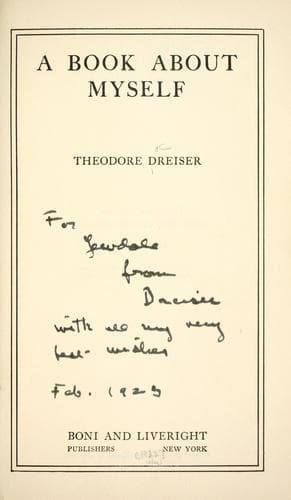
Dreiser, Theodore, 1871-1945; Journalists -- United States -- Biography; Novelists, American -- 20th century -- Biography
And he had the strangest, fussiest, bossiest love of great literature of
any one I have ever known, especially in the realm of the newspapers.
Zola at this time was apparently his ideal of what a writer should be,
and after him Balzac and Loti. He seemed to know them well and to admire
and even love them, after his fashion. He was always calling upon me to
imitate Zola’s vivid description of the drab and the gross and the
horrible if I could, assuming that I had read him, which I had not, but
I did not say so. And Balzac’s and Loti’s sure handling of the sensual
and the poignant! How often have I heard him refer to them with
admiration, giving me the line and phrase of certain stark pictures, and
yet at the same time there was a sneaking bending of the knee to the
middle West conventions of which he was a part, a kind of horror of
having it known that he approved of these things. He was a Shriner and
very proud of it, as he was of various other local organizations to
which he belonged. He had the reputation of being one of the best city
editors in the city, far superior to my late master. Previously he had
been city editor of the _Globe_ itself for many years and was still
favorably spoken of in that office. After I left St. Louis he returned
to the _Globe_ for a time and once more became its guide in local news.
But that is neither here nor there save as it illustrates what is a
cardinal truth of the newspaper world: that the best of newspaper men
are occasionally to be found on the poorest of papers, and vice versa.
Just at this time, as I understood, he was here because the _Republic_
was making a staggering effort to build itself up in popular esteem,
which it finally succeeded in doing after McCullagh’s death, becoming
once more the leading morning paper as it had been before the _Globe_,
under McCullagh, arose to power. Just now, however, in my despondent
mood, it seemed an exceedingly sad affair.
Mr. Wandell, as I now learned, had heard of me and my recent _faux pas_,
as well as some of the other things I had been doing.
“Been working on the _Globe_, haven’t you?” he commented when I
approached him. “What did they pay you?”
I told him.
“When did you leave there?”
“About a week ago.”
“Why did you leave?”
“Perhaps you saw those notices of three shows that didn’t come to town?
I’m the man who wrote them up.”
“Oho! ho! ho!” and he began eyeing me drily and slapping his knee. “I
saw those. Ha! ha! ha! Ha! ha! ha! Yes, that was very funny—very. We had
an editorial on it. And so McCullagh fired you, did he?”
“No, sir,” I replied indignantly. “I quit. I thought he might want to,
and I put a letter on his desk and left.”
“Ha! ha! ha! Quite right! That’s very funny! I know just how they do
over there. I was city editor there myself once. They write them up in
advance sometimes. We do here. Where do you come from?”
I told him. He meditated awhile, as though he were uncertain whether he
needed any one.
Public-domain text, read in full here on John Shaqi.
Reviews
Reviews
No reviews yet
Be the first to share your thoughts on this work.
Elsewhere in the archive
Join the Discussion
Join the discussion
Sign in to leave a comment or review.
Sign InorCreate an account